
In the construction industry, concrete slabs are fundamental. Yet, inaccurate estimates for these foundational elements can derail an entire project budget. Industry reports suggest that poor material quantity takeoffs alone can lead to cost overruns of 10-15% on structural concrete work. Understanding how to estimate concrete slab cost precisely is not just beneficial; it is critical for project success.
At Phoenix Estimations, with over 2,000 completed projects and 4,000+ satisfied clients across the US and Canada, we have seen firsthand what accurate estimating does for project outcomes. We understand the nuances of concrete pour cost and the complexities of a slab on grade estimate. This guide will walk you through the essential components of concrete slab cost estimation. You will learn to account for materials, labor, and other critical factors, ensuring your next bid is both competitive and profitable.
TL;DR Summary
- Core Insight: Accurate concrete slab cost estimation is vital for project profitability and avoiding budget overruns.
- Key Process: A detailed breakdown accounts for materials (concrete, rebar, formwork), labor, equipment, and site-specific factors.
- Primary Benefit: Ensures competitive bidding, effective budget control, and enhanced client trust.
- Action Step: Implement systematic estimation methods or partner with professional services like Phoenix Estimations for precision.
Table of Contents
- What Is Concrete Slab Cost Estimation?
- Why Accurate Concrete Slab Cost Estimation Matters for Your Project
- How to Estimate Concrete Slab Costs Step-by-Step
- Tools and Methods for Concrete Slab Cost Estimation
- Real-World Example — How Phoenix Estimations Solved It
- Common Concrete Slab Estimating Mistakes to Avoid
- Benefits of Professional Concrete Slab Estimating Services
- FAQ Section
- Key Takeaways
- Ready for Accurate Concrete Slab Estimates?
- Conclusion
- Resources
What Is Concrete Slab Cost Estimation?
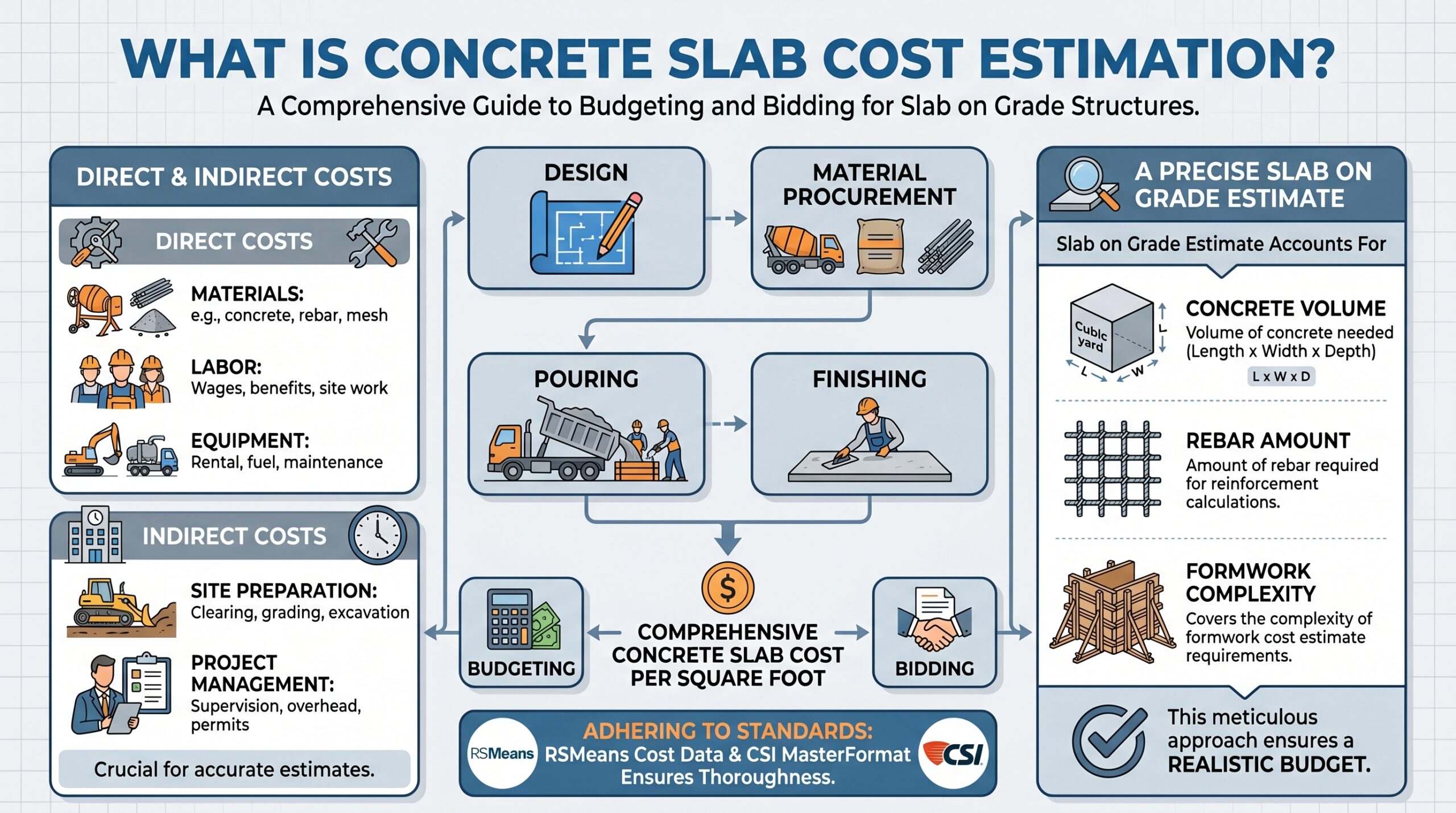
Concrete slab cost estimation involves calculating all expenses associated with the design, material procurement, pouring, and finishing of a concrete slab structure. This includes direct costs like materials (e.g., concrete, rebar), labor, and equipment, alongside indirect costs such as site preparation and project management. It aims to provide a comprehensive concrete slab cost per square foot for budgeting and bidding. Adhering to standards like RSMeans cost data and CSI MasterFormat ensures thoroughness.
A precise slab on grade estimate accounts for every component. This includes the volume of concrete needed and the amount of rebar for slab estimate calculations. It also covers the complexity of formwork cost estimate requirements. This meticulous approach ensures a realistic budget.
Why Accurate Concrete Slab Cost Estimation Matters for Your Project
Accurate concrete slab cost estimation is not merely good practice; it is a strategic imperative. Miscalculations can lead to significant financial losses, eroding profit margins or causing project delays. For instance, underestimating concrete pour cost by just 5% on a $100,000 slab project can result in a $5,000 unbudgeted expense.
- Cost Control: Prevents budget overruns by providing a clear financial roadmap from the outset.
- Bid Success: Enables competitive bidding without sacrificing profitability, crucial in the 2025 construction market.
- Risk Mitigation: Identifies potential cost pitfalls early, allowing for proactive adjustments and better overall project budgeting.
- Client Trust: Delivers transparency and reliability, strengthening relationships and securing future work.
- Resource Allocation: Optimizes material procurement and labor scheduling, improving project efficiency.
This detailed understanding extends beyond just the concrete itself, encompassing adjacent topics like overall project scheduling and effective risk management. It ensures a holistic approach to project planning.
Struggling with estimate accuracy? Our construction estimating service at https://phoenixestimations.com/construction-estimating-service delivers bid-ready numbers fast.
How to Estimate Concrete Slab Costs Step-by-Step
Estimating concrete slab costs requires a structured approach. We break it down into key phases, ensuring no detail is overlooked.
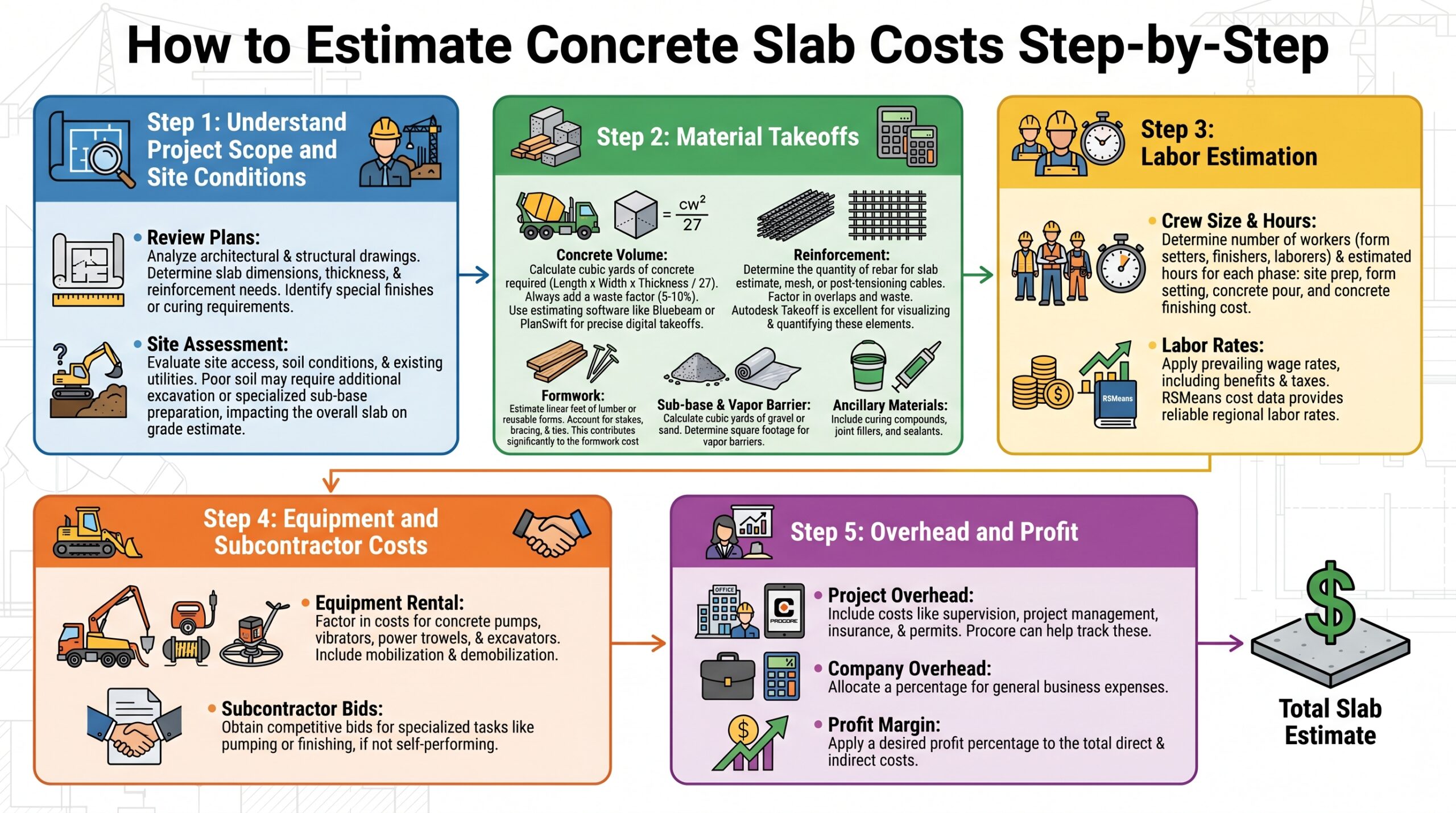
Step 1: Understand Project Scope and Site Conditions
- Review Plans: Analyze architectural and structural drawings. Determine slab dimensions, thickness, and reinforcement needs. Identify any special finishes or curing requirements.
- Site Assessment: Evaluate site access, soil conditions, and existing utilities. Poor soil may require additional excavation or specialized sub-base preparation, impacting the overall slab on grade estimate.
Step 2: Material Takeoffs
- Concrete Volume: Calculate the cubic yards of concrete required (Length x Width x Thickness / 27). Always add a waste factor (5-10%). Use estimating software like Bluebeam or PlanSwift for precise digital takeoffs.
- Reinforcement: Determine the quantity of rebar for slab estimate, mesh, or post-tensioning cables. Factor in overlaps and waste. Autodesk Takeoff is excellent for visualizing and quantifying these elements.
- Formwork: Estimate linear feet of lumber or reusable forms. Account for stakes, bracing, and ties. This contributes significantly to the formwork cost estimate.
- Sub-base & Vapor Barrier: Calculate cubic yards of gravel or sand. Determine square footage for vapor barriers.
- Ancillary Materials: Include curing compounds, joint fillers, and sealants.
Step 3: Labor Estimation
- Crew Size & Hours: Determine the number of workers (form setters, finishers, laborers) and the estimated hours for each phase: site prep, form setting, concrete pour, and concrete finishing cost.
- Labor Rates: Apply prevailing wage rates, including benefits and taxes. RSMeans cost data provides reliable regional labor rates.
Step 4: Equipment and Subcontractor Costs
- Equipment Rental: Factor in costs for concrete pumps, vibrators, power trowels, and excavators. Include mobilization and demobilization.
- Subcontractor Bids: Obtain competitive bids for specialized tasks like pumping or finishing, if not self-performing.
Step 5: Overhead and Profit
- Project Overhead: Include costs like supervision, project management, insurance, and permits. Procore can help track these.
- Company Overhead: Allocate a percentage for general business expenses.
- Profit Margin: Apply a desired profit percentage to the total direct and indirect costs.
Tools and Methods for Concrete Slab Cost Estimation
The right tools and methods can transform a complex concrete slab estimate into a precise, efficient process. We leverage advanced software and industry-leading standards.
Key Software and Standards
- Bluebeam: For precise 2D and 3D takeoffs, allowing detailed measurement of concrete volumes, rebar lengths, and formwork areas.
- PlanSwift: A powerful digital takeoff tool for quickly quantifying materials from digital plans, crucial for a fast slab on grade estimate.
- Procore: Excellent for project management, tracking costs, and managing budgets, ensuring the estimate aligns with execution.
- RSMeans: Provides up-to-date, localized cost data for materials, labor, and equipment, essential for accurate concrete pour cost calculations.
- Autodesk Takeoff: Offers advanced capabilities for 3D model-based takeoffs, enhancing accuracy for complex slab designs.
- CSI MasterFormat: Ensures a standardized classification of construction costs, helping organize the estimate systematically.
Comparison: Manual vs. Digital/Software Methods
| Factor | Manual Method | Digital/Software Method |
|---|---|---|
| Speed | Slow, labor-intensive | Fast, automated calculations |
| Accuracy | Prone to human error, less precise | High precision, fewer errors with detailed takeoffs |
| Cost | Lower initial tool cost, higher labor cost | Higher initial software investment, lower long-term labor cost |
| Scalability | Limited by time and workforce | Easily scales for multiple projects or complex designs |
| Audit Trail | Difficult to trace calculations | Clear, documented, and easily revisable calculations |
At Phoenix Estimations, we combine the best of these tools with our team’s expertise. This ensures highly accurate and efficient cost estimating services.
Real-World Example — How Phoenix Estimations Solved It
Precise concrete slab cost estimation is more than just numbers; it’s about real-world impact. Consider our work on the Lincoln University exterior finishes project.
The Challenge: The university faced budget constraints for a large-scale exterior renovation, which included significant concrete pathways and plaza areas. The initial estimates from various sources showed discrepancies in material quantities and labor for concrete work, threatening to push the project over budget without compromising design integrity.
Our Action: Our team at Phoenix Estimations performed detailed material takeoffs for all concrete elements using advanced software like PlanSwift and Bluebeam. We meticulously calculated the concrete pour cost, rebar for slab estimate, and formwork cost estimate. We applied RSMeans data to ensure accurate local labor and material pricing. Furthermore, we conducted value engineering, identifying opportunities to optimize concrete mix designs and finishing techniques without impacting quality.
The Outcome: Our precise data-backed estimate identified correct materials and quantities, significantly reducing potential waste. This allowed the client to make informed decisions, keeping the concrete work within budget while maintaining the aesthetic and structural requirements. The project was completed on schedule and within financial parameters, demonstrating the power of accurate, value-engineered estimation.
Common Concrete Slab Estimating Mistakes to Avoid
Even seasoned professionals can fall victim to common pitfalls in concrete slab cost estimation. Avoiding these errors is crucial for project profitability.
- Inaccurate Material Takeoffs: Underestimating concrete volume or rebar quantities. This often happens by not accounting for waste, over-excavation, or irregular slab shapes. Consequences include material shortages, costly rush orders, and project delays.
- Ignoring Site Preparation Costs: Overlooking expenses for excavation, grading, soil compaction, or specialized sub-base materials. A poor sub-base can lead to slab failure, requiring expensive rework.
- Underestimating Labor Productivity: Assuming ideal conditions for concrete pour and finishing. Factors like weather, site access, and crew experience can significantly impact labor hours. This directly inflates the concrete finishing cost.
- Neglecting Formwork Complexity: Failing to account for complex slab designs (e.g., curves, multiple levels) that require custom or more labor-intensive formwork. This can severely impact the formwork cost estimate.
- Forgetting Ancillary Costs: Omitting items like vapor barriers, control joints, curing compounds, or special finishes. These small costs add up and can lead to budget shortfalls.
- Not Accounting for Regional or Market Fluctuations: Relying on outdated or generic cost data. Material and labor costs vary significantly by region and can change rapidly, impacting the overall concrete slab cost per square foot.
Benefits of Professional Concrete Slab Estimating Services
For complex projects or tight deadlines, partnering with professional estimating firms like Phoenix Estimations offers distinct advantages. We provide a strategic edge in a competitive market.
- Unmatched Accuracy: Our team of 15+ year veteran estimators uses advanced software and current RSMeans data. This ensures precise material takeoffs and labor calculations, reducing risk.
- Time Savings: We deliver fast turnaround times for detailed estimates, freeing up your team to focus on project management and execution. This is critical for meeting bid deadlines.
- Increased Bid Win Rates: Our comprehensive, bid-ready deliverables give you a competitive edge. They provide the confidence to submit compelling proposals.
- Risk Reduction: We identify potential cost overruns and value engineering opportunities. This minimizes financial exposure and enhances project ROI.
- Expertise Across Sectors: Whether it’s residential, commercial, or industrial concrete estimating services, we have the specialized knowledge. Our team covers everything from basic slab on grade estimates to complex structural concrete.
- Access to Advanced Tools: You gain the benefit of cutting-edge software like Bluebeam, PlanSwift, and Autodesk Takeoff without the overhead.
Leveraging professional services means investing in expertise that pays dividends through efficiency and profitability.
FAQ Section
Q: What is the average concrete slab cost per square foot for a standard project?
A: The average concrete slab cost per square foot can range from $4 to $10, depending on thickness, reinforcement, and finish. This figure includes materials, labor for pouring, and basic finishing. Specialized requirements or complex site conditions will increase this cost.
Q: How do you calculate the concrete pour cost for a large commercial slab?
A: For large commercial slabs, we calculate concrete pour cost by determining the total cubic yards of concrete needed, factoring in a waste percentage. We then multiply this by the local unit cost of concrete, including delivery and pumping fees. Labor and equipment are estimated separately per square foot.
Q: What factors most significantly impact a slab on grade estimate?
A: Key factors impacting a slab on grade estimate include slab thickness, soil conditions requiring extensive excavation or fill, reinforcement type (rebar, mesh), and the chosen concrete finish. Site accessibility and regional labor rates also play a substantial role in the final cost.
Q: Is it more cost-effective to use a professional service for a rebar for slab estimate?
A: Yes, using a professional service like Phoenix Estimations for a rebar for slab estimate is often more cost-effective. Our experts use precise takeoff software to minimize waste and ensure compliance with structural plans, preventing costly errors and delays that can occur with manual calculations.
Q: What does a typical concrete finishing cost include?
A: A typical concrete finishing cost includes the labor and specialized equipment (e.g., power trowels) required to achieve the desired surface texture and smoothness. This can range from a basic broom finish to a smooth troweled or decorative stamped finish, with each requiring different labor hours and expertise.
Key Takeaways
- Accurate concrete slab cost estimation is fundamental for project financial health.
- A detailed, step-by-step approach covering all cost components is non-negotiable.
- Ignoring common estimating mistakes can lead to significant budget overruns and project delays.
- Phoenix Estimations provides precise, data-backed estimates, saving time and increasing bid success rates.
Ready for Accurate Concrete Slab Estimates?
Are unexpected costs impacting your project profitability? At Phoenix Estimations, we have delivered accurate trade-specific estimates and detailed takeoffs for 2,000+ projects across residential, commercial, and industrial sectors in the US and Canada — with turnaround times that match your bid schedule. Our expertise in concrete slab cost, rebar for slab estimate, and concrete finishing cost ensures your bids are precise and competitive. Request a Construction Estimate: https://phoenixestimations.com/construction-estimating-service | Get a Professional Quantity Takeoff: https://phoenixestimations.com/quantity-takeoff-services | Contact us: https://phoenixestimations.com/contactUs.php
Conclusion
Mastering how to estimate concrete slab cost is a cornerstone of successful construction project management. From the initial slab on grade estimate to the final concrete finishing cost, every detail impacts your bottom line. By systematically accounting for materials, labor, equipment, and potential risks, you empower your bids with accuracy and confidence. This precision not only wins projects but also builds a reputation for reliability and financial foresight.
At Phoenix Estimations, we are committed to providing the detailed, bid-ready estimates you need to thrive. Our blend of seasoned expertise and advanced technology ensures that your concrete slab projects are built on a solid financial foundation. Partner with us to transform your estimating challenges into profitable opportunities.