
A cost estimate and a cost budget are not the same document. Treating them as identical is one of the most common — and costly — mistakes in construction project management.
Understanding the difference between a cost estimate and a cost budget in construction protects your project from underfunded scopes, missed contingencies, and owner disputes before a single foundation is poured.
At Phoenix Estimations, with over 2,000 completed projects and 4,000+ satisfied clients across the US and Canada, we’ve seen firsthand what accurate estimating does for project outcomes. Developers and project owners who blur this line regularly face budget shortfalls when real costs surface during construction.
In this guide, you’ll learn exactly what each term means, how one becomes the other, and why the distinction matters on every project you manage.
| TL;DR — What You’ll Learn A cost estimate is a calculated projection of likely costs — used for bidding and planningA cost budget is an owner-approved financial limit — used for financial control during constructionThe estimate is the input; the budget is the decision made from that inputPhoenix Estimations produces the precise estimates that make your budget reliable from day one |
TABLE OF CONTENTS
1. What Is a Construction Cost Estimate?
2. What Is a Construction Cost Budget?
3. How a Cost Estimate Becomes a Cost Budget
4. Why the Difference Matters in Real Projects
5. How Phoenix Estimations Helps with Both
6. FAQ
7. Key Takeaways
What Is a Construction Cost Estimate?
| Definition: A construction cost estimate is a calculated projection of the likely costs required to complete a defined scope of work — based on available drawings, specifications, and market pricing at a point in time. Its primary purpose is bidding, planning, and feasibility analysis. |
A cost estimate answers the question: “What will this project likely cost?”
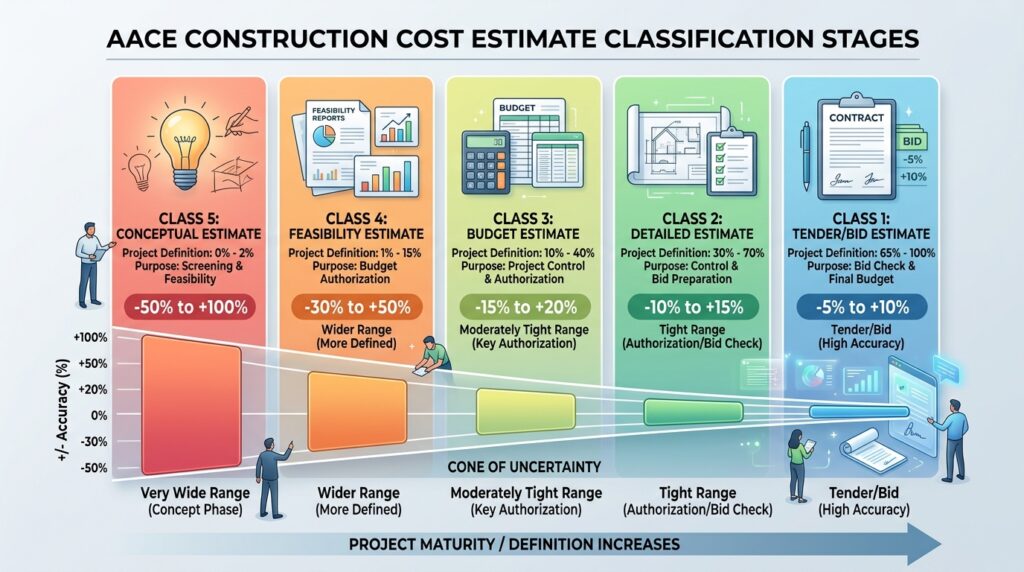
Estimates are produced at multiple stages of a project lifecycle — from conceptual/preliminary estimates early in design, to detailed bid estimates when construction documents are complete. Each stage carries a different level of accuracy and a different purpose.
A well-structured construction cost estimate includes:
- Material quantities and unit costs
- Labour hours and labour rates by trade
- Equipment costs and mobilization
- Subcontractor allowances
- Overhead and profit margins
- Escalation provisions for long-duration projects
Industry standards from AACE International classify estimates by Class (Class 5 through Class 1), with accuracy ranging from ±50% at conceptual stage to ±5–10% at final bid stage. Our preliminary estimating services follow these classifications to ensure owners understand exactly what level of certainty they’re working with.
A cost estimate is not a commitment. It is a professional projection — subject to scope changes, market fluctuations, and design evolution.
Cost Estimate vs Cost Budget — At a Glance
| Factor | Cost Estimate | Cost Budget |
| Produced by | Estimator / cost consultant | Owner / project manager |
| Purpose | Projection of likely costs | Authorized spending limit |
| Timing | During design & pre-construction | After estimate review & approval |
| Includes contingency? | No — added separately | Yes — built in |
| Includes soft costs? | Typically no | Yes — permits, fees, financing |
| Can it change? | Yes — updated with design changes | Yes — via formal change control |
| Used for | Bidding, planning, feasibility | Financial control during construction |
What Is a Construction Cost Budget?
| Definition: A construction cost budget is an owner-approved financial limit that governs how much will be spent on a project. It is set by the project owner — not the estimator — and serves as the financial control document throughout design and construction. |
A cost budget answers the question: “How much are we authorized to spend?”
The budget is a decision, not a calculation. It takes the estimate as its primary input, then layers on owner judgment, contingency allocations, value engineering outcomes, and financial constraints.
A construction cost budget typically includes:
- The base cost estimate (as approved)
- Design and owner contingency (typically 5–15% above the estimate)
- Permits, fees, and soft costs
- Financing and carrying costs
- Owner-held reserves for scope changes
The budget is the financial ceiling. Every change order, scope addition, and cost overrun is measured against it. Once set, the budget drives procurement decisions, design trade-offs, and contractor negotiations throughout the project.
This is why the budget cannot simply be the estimate — the estimate doesn’t include contingency, soft costs, or financial reserves. Using a raw estimate as your budget leaves zero room for the unexpected.
How a Cost Estimate Becomes a Cost Budget
The path from estimate to budget is a deliberate process — not an automatic one. Here’s how it works on a well-managed construction project:
- Step 1: Produce the base cost estimate
The estimating team prepares a detailed cost estimate based on current drawings, specifications, and market rates. This is the foundation of everything that follows.
- Step 2: Review estimate for completeness
The owner or project manager reviews the estimate for scope gaps, exclusions, and assumptions. Missing scope at this stage becomes a budget shortfall later.
- Step 3: Add contingency
Contingency is added based on project risk, design completeness, and estimate class. A Class 3 estimate with significant design uncertainty warrants higher contingency than a Class 1 bid estimate.
- Step 4: Add soft costs and owner costs
Permits, professional fees, financing costs, legal costs, and owner-managed scope items are added to reach the total project cost — not just the hard construction cost.
- Step 5: Apply value engineering if needed
If the total project cost exceeds the owner’s financial target, value engineering identifies scope or specification changes that reduce cost without compromising function.
- Step 6: Owner approves the budget
The owner formally approves the total project cost as the authorized budget. This approval transforms the estimate into a budget — and from this point forward, all costs are tracked against it.
| The accuracy of your budget depends entirely on the accuracy of your estimate. Phoenix Estimations gives you the reliable foundation. Get a quote → |
Why the Difference Matters in Real Projects
Confusing a cost estimate with a cost budget creates real financial risk. Across 2,000+ projects, our team at Phoenix Estimations has seen this mistake play out in predictable ways.
The most common consequence: A developer receives a preliminary estimate of $4.2M and immediately declares that the project budget is $4.2M. No contingency. No soft costs. No room for scope evolution. Three months into construction, change orders, unforeseen conditions, and design revisions push the real cost to $4.9M. The project is now $700,000 over a budget that was never properly built in the first place.
Why this happens:
- Estimates are produced before all design decisions are finalized
- Material prices shift — in 2025 and into 2026, construction input costs have remained volatile across North American markets
- Field conditions create unforeseen costs not visible in drawings
- Owner-initiated changes are not reflected in the original estimate
The fix is straightforward: treat the estimate as the input and build a budget that includes adequate contingency — typically 5–10% for well-defined commercial projects and 10–20% for complex or early-stage residential development.
Linking your budget control process to a precise, itemized estimate — rather than a rough ballpark — is the single highest-impact step owners can take to protect project financial outcomes.
| Treating an estimate as a hard budget without contingency is one of the most common construction finance mistakes. Let us help you avoid it. Contact us → |
How Phoenix Estimations Helps with Both
Phoenix Estimations produces the estimate. You set the budget. But our estimates make your budget far more reliable.
On the estimating side, our team uses RSMeans cost data, Bluebeam, PlanSwift, and Autodesk Takeoff to produce accurate, itemized cost estimates across all construction trades and sectors. We follow CSI MasterFormat structure so estimates integrate cleanly with your project management and accounting workflows.
On the budgeting side, we help owners and developers understand:
- Which estimate class they’re working with — and what accuracy range to expect
- Where contingency should be set based on design maturity and project risk
- Which line items are most exposed to market volatility heading into 2026
- How to structure a budget that accommodates change without project-level crisis
Our cost estimating service is used by developers, general contractors, project managers, and owners across the US and Canada to build the financial foundation their budgets depend on.
Case Study: Crunch Fitness, California — Budget Overruns from Estimate Misalignment
Discrepancies in interior finishes specifications caused budget overruns and scheduling delays on a Crunch Fitness renovation. The project owner had been working from an estimate that hadn’t been properly translated into a fully provisioned budget. Our team identified the cost-impacting variances, delivered an updated estimate aligned with design intent, and helped the client regain full budget control — without further delays.
This is exactly the gap we close: between what an estimate shows and what a budget needs to survive a real project.
FAQ
Q: What is the difference between a cost estimate and a cost budget in construction?
A: A cost estimate is a calculated projection of likely project costs, produced by an estimator based on drawings, specs, and market pricing. A cost budget is an owner-approved financial limit that uses the estimate as its input and adds contingency, soft costs, and reserves. The estimate is the calculation; the budget is the decision made from it.
Q: How does a construction cost estimate become a project budget?
A: The process involves reviewing the base estimate for completeness, adding contingency based on project risk and design maturity, incorporating soft costs (permits, fees, financing), applying value engineering if costs exceed targets, and obtaining formal owner approval. Only after that approval does the estimate become an authorized budget that governs project spending.
Q: Why is it risky to treat a construction estimate as a hard budget?
A: A raw estimate reflects costs at a point in time, before all design decisions are made and before field conditions are known. It contains no contingency, no soft costs, and no reserves for owner-initiated changes. Using it directly as a budget creates a financial ceiling with no buffer — and even small project changes will push costs over that ceiling.
Q: Who sets the cost budget on a construction project?
A: The project owner or developer sets and approves the cost budget. Estimators, project managers, and cost consultants inform the budget — but the financial authorization decision belongs to the owner. The estimate is the professional input; the budget is the owner’s formal commitment to a spending limit for the project.
Q: How much contingency should be added to a construction estimate?
A: Contingency depends on estimate class and project risk. Well-defined commercial projects with complete construction documents typically carry 5–10% contingency. Early-stage residential development or complex projects with significant design uncertainty warrant 10–20%. Phoenix Estimations advises clients on appropriate contingency levels as part of our cost estimating service.
Key Takeaways
- A cost estimate is a professional projection of likely costs — it is not a financial commitment
- A cost budget is an owner-approved spending limit — built from the estimate, not identical to it
- The most common project finance mistake is using a raw estimate as a hard budget, with no contingency or soft costs included
- Contingency of 5–20% above the base estimate is standard practice, depending on project risk and design completeness
- Phoenix Estimations produces the precise, itemized estimates that give owners the reliable foundation to build a realistic project budget
| Get Your Project Started Right Every construction budget is only as strong as the estimate it’s built on. At Phoenix Estimations, we’ve delivered accurate, trade-specific estimates and detailed takeoffs for 2,000+ projects across residential, commercial, and industrial sectors in the US and Canada — with turnaround times that match your project schedule. 👉 Request a Construction Cost Estimate 👉 Explore Preliminary Estimating Services Contact us today and get your project started right. |
Conclusion
The difference between a cost estimate and a cost budget in construction is not a technicality — it’s the foundation of sound project financial management. An estimate tells you what a project will likely cost. A budget tells you what you’re authorized to spend. One is a calculation; the other is a decision. Getting both right — and understanding how one feeds the other — is what separates projects that finish on budget from those that don’t. Start with an accurate estimate. Build a realistic budget. Then manage to it.
External Resources
- AACE International — Cost Estimate Classification System
- Construction Specifications Institute (CSI) — MasterFormat
- RS Means / Gordian — Construction Cost Data
- National Institute of Building Sciences
- Engineering News-Record (ENR) — Construction Cost Trends
About the Author
Phoenix Estimations Editorial Team
This article was written by the estimating professionals at Phoenix Estimations — a construction cost estimating company with 8 years of experience, 2,000+ completed projects, and 4,000+ satisfied clients across the United States and Canada. Our team includes certified estimators with backgrounds in general contracting, subcontracting, and project management across residential, commercial, and industrial sectors. We use industry-leading tools including Bluebeam, PlanSwift, RSMeans, and Autodesk Takeoff to deliver accurate, bid-ready estimates