
Missing just a few accessories on a metal stud framing estimate can erase $8,000–$15,000 from a commercial project’s margin before a single stud is installed. Most contractors don’t undercount the studs — they undercount everything around them.
Knowing how to estimate metal stud framing costs accurately means accounting for track, blocking, headers, angles, fasteners, deflection track, fire stopping, and labour — not just the studs themselves. At Phoenix Estimations, with over 2,000 completed projects and 4,000+ satisfied clients across the US and Canada, we’ve seen firsthand what a precise, complete framing estimate does for project outcomes.
In this guide, you’ll learn exactly what a metal stud framing estimate must include, how to measure from drawings, current cost ranges by gauge and height, and the accessories most estimators miss. Whether you’re bidding a commercial tenant fit-out or a large interior partition scope, this walkthrough will help you produce numbers you can stand behind.
| TL;DR — What You’ll Learn: • Metal stud framing estimates must include track, accessories, backing, and fire stopping — not just studs • Use linear footage of partitions and stud spacing to calculate accurate stud counts • Cost ranges vary by stud gauge (25 ga–16 ga) and wall height — labour-to-material ratios shift significantly in commercial • Accessories add 15–25% to material cost and are the #1 source of framing estimate shortfalls • Phoenix Estimations delivers complete, bid-ready framing takeoffs for contractors who can’t afford to guess |
Table of Contents
- What Metal Stud Framing Estimating Includes
- How to Measure and Count Metal Studs from Drawings
- Metal Stud Framing Cost Ranges Per Linear Foot
- Accessories and Miscellaneous Items That Get Missed
- When to Use a Professional Framing Estimating Service
- Real-World Example: How Phoenix Estimations Solved It
- Common Metal Stud Framing Estimating Mistakes to Avoid
- FAQ
- Key Takeaways
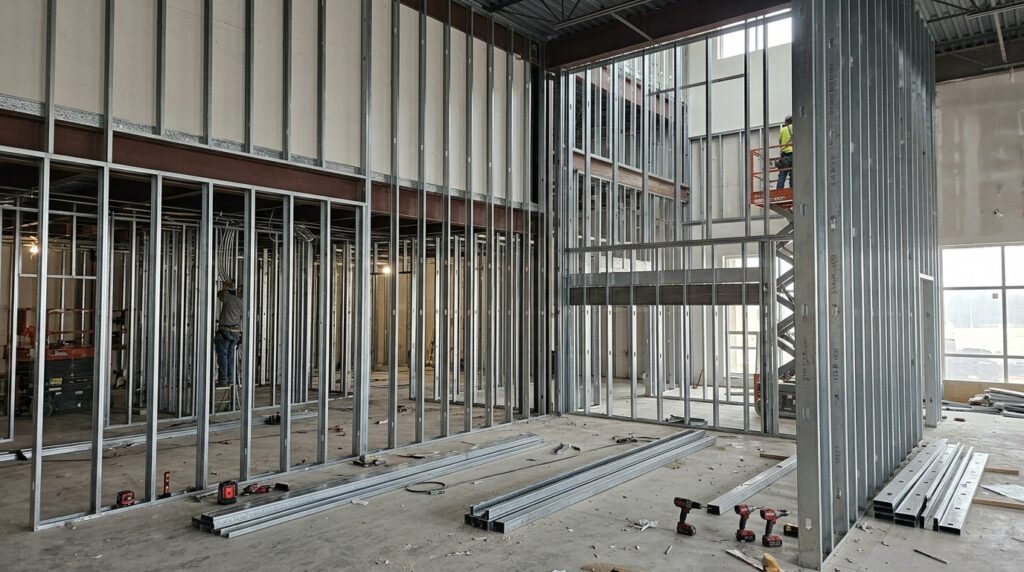
What Metal Stud Framing Estimating Includes
| Definition: Metal stud framing estimating is the process of quantifying all materials, labour, and accessories required to install light gauge steel partition walls and framing assemblies — covering tracks, studs, blocking, headers, angles, fasteners, backing, and associated components — based on project drawings and specifications. |
Most contractors who undercount their framing scope skip the scope overview and jump straight to the stud list. That’s where estimate blowouts begin.
A complete metal stud framing estimate covers the following components:
- Floor and ceiling track (runner track)
- Vertical studs — all gauges (25 ga, 20 ga, 18 ga, 16 ga)
- Blocking and bridging
- Headers at door and window openings
- Angles, clips, and connection hardware
- Fasteners (screws, anchors, powder-actuated pins)
- Backing boards for fixtures, millwork, and equipment
- Deflection track at slab soffit (non-negotiable in commercial)
- Sound isolation clips (where specified)
- Fire stopping at penetrations and rated assemblies
The CSI MasterFormat classifies metal stud framing under Division 09 — Finishes, specifically Section 09 22 16 (Non-Structural Metal Framing). Every element listed above falls within this scope. Reference this standard when structuring your takeoff to ensure nothing gets overlooked.
In 2025 and into 2026, supply chain stabilization has made stud material pricing more predictable than during the post-pandemic volatility years — but labour costs for skilled framing crews in both the US and Canada continue to climb, making labour accuracy just as critical as material accuracy.
How to Measure and Count Metal Studs from Drawings
Accurate stud counts start with linear footage — not square footage. Here’s the formula that experienced estimators use:
Step 1: Calculate Linear Feet of Partitions
On your drawings, measure the total run of each partition type. Group by stud height since wall height determines stud length and gauge requirements. Use Bluebeam Revu or PlanSwift to measure directly from digital plans — manual scaling on printed drawings introduces 3–8% error.
Step 2: Apply Stud Spacing Count
Divide the linear footage by the stud spacing (typically 16″ or 24″ on centre) to get the stud count per run. Add 1 for the end stud. For 16″ OC spacing: (Linear feet × 12 ÷ 16) + 1 = stud count. For 24″ OC: (Linear feet × 12 ÷ 24) + 1 = stud count.
Step 3: Add Door and Window Openings
Each opening requires cripple studs, king studs, and a header assembly. A standard single door opening (3’0″ width) typically requires 2 king studs + 2 cripples + 1 header. Count every opening and itemise header lengths separately.
Step 4: Add Track Quantities
Track = 2× the linear footage (floor + ceiling), plus additional track at all openings and any mid-height blocking lines. Track is sold in 10-foot lengths — round up to the nearest full stick count.
Step 5: Apply a 10–15% Waste Factor
Field cuts, damaged material, and offcuts add 10–15% to stud and track quantities on a typical commercial project. Use 12% as a standard allowance unless the layout is unusually regular.
| Need this done faster? Our team uses Bluebeam, PlanSwift, and Autodesk Takeoff to deliver complete metal stud framing takeoffs from your drawings — fast. 👉 Explore our metals estimating services — bid-ready framing numbers without the manual grind. |
Metal Stud Framing Cost Ranges Per Linear Foot
Cost ranges vary by stud gauge, wall height, project type, and regional labour markets. The figures below reflect current US and Canadian market data through 2025.
| Stud Type / Gauge | Stud Spacing | Wall Height | Material Cost / LF | Labour / LF (Commercial) |
| 25 ga (Non-structural) | 16″ OC | Up to 10 ft | $1.80–$2.60 | $3.50–$5.00 |
| 20 ga (Light commercial) | 16″ OC | 10–14 ft | $2.40–$3.40 | $4.50–$6.50 |
| 18 ga (Mid commercial) | 16″ OC | 14–18 ft | $3.20–$4.80 | $6.00–$9.00 |
| 16 ga (Heavy commercial) | 16″ OC | 18 ft+ | $4.50–$6.50 | $8.00–$13.00 |
Important: For commercial metal stud framing, labour typically runs 55–65% of total installed cost. A scope where contractors underestimate labour-to-material ratio is one of the most common drivers of bid losses and margin erosion on commercial tenant improvement projects.
In high-density urban markets (New York, Toronto, Los Angeles, Vancouver), commercial framing labour rates run 20–35% higher than national averages. Always apply local RSMeans data or verify with current subcontractor quotes before finalising a bid.
Accessories and Miscellaneous Items That Get Missed
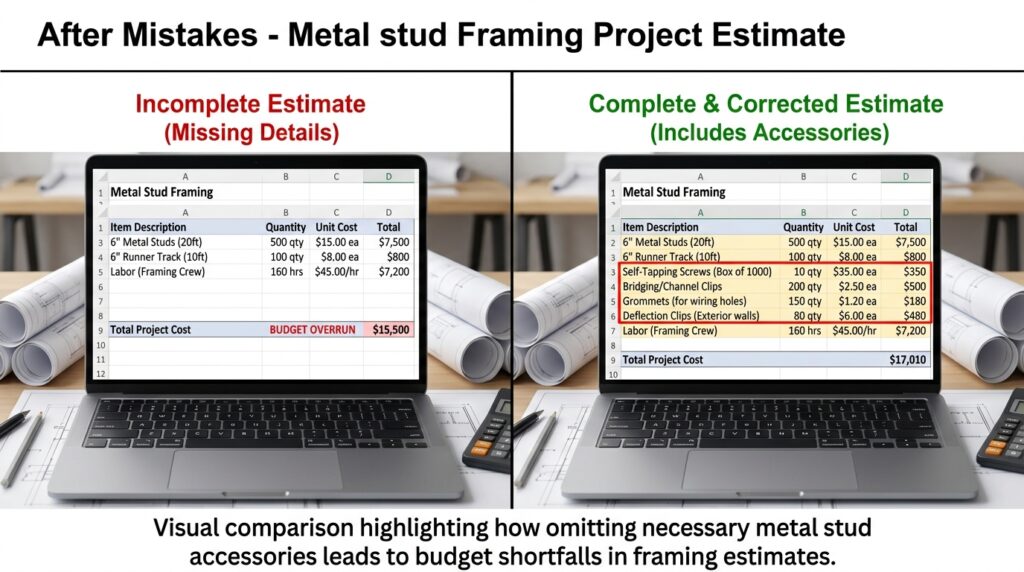
This section is where most framing estimates fall apart. Accessories routinely add 15–25% to total framing material cost — and they’re the items most commonly excluded from scope.
Here are the most frequently missed line items in metal stud framing estimates:
- Deflection track (slotted ceiling track): Required at all suspended ceiling slab soffits. It is not optional in commercial construction — building codes require it for seismic and live load deflection. Missing this from scope is both a cost error and a code compliance issue.
- Sound isolation clips (resilient channels): Specified in acoustically rated assemblies. Often appears only in the spec section, not flagged on plans. Always cross-reference Division 09 specifications.
- Fire stopping at penetrations: MEP penetrations through rated stud walls require firestopping — this is a separate cost from framing labour. Confirm scope division with the mechanical contractor.
- Backing boards: 5/8″ plywood or blocking for toilet accessories, millwork, whiteboards, heavy equipment, and TV mounts. Quantities require a fixture schedule review, not just plan reading.
- Framing at soffits and bulkheads: Dropped ceiling soffits and bulkheads around ductwork and pipes are often treated as ‘assumed in scope’ — clarify in your bid qualifications.
- Kick-out angles and transition clips: Required at floor-to-ceiling transitions and at structural connections. Low unit cost, but easy to miss in quantity.
| Accessories add 15–25% to framing material cost — and most estimates miss them. Ours never do. Send us your drawings → Get a complete framing takeoff from Phoenix Estimations |
Real-World Example: How Phoenix Estimations Solved It
Bit Fuel, Porter TX — Inaccurate Metal Material Estimations
At Bit Fuel in Porter, TX, inaccurate metal material estimations caused significant project delays and cost overruns. The original estimate had undercounted stud quantities across multiple wall heights and completely excluded backing requirements for heavy equipment installations.
Phoenix Estimations stepped in with precise metal takeoffs using Bluebeam and PlanSwift — identifying correct materials, gauges, and quantities across all partition types. We delivered a reliable, complete estimate that brought the project back on schedule and gave the contractor a defensible number to present to the client.
The KEG, Dixon Road — Budget Discrepancies in Exterior Framing
The KEG Dixon Road faced significant budget discrepancies stemming from inaccurate exterior construction cost estimates, including framing scope. Our team delivered precise material, labour, and overhead cost estimates using advanced tools and industry-standard methodologies — resolving the discrepancy and keeping the project on track for completion.
Both projects illustrate the same pattern: estimate shortfalls in framing scope are almost always caused by incomplete accessory takeoffs and incorrect gauge/height assumptions — not by miscounting studs.
Common Metal Stud Framing Estimating Mistakes to Avoid
These are the six errors our team sees most consistently when reviewing contractor-submitted framing estimates:
- Confusing metal stud framing with structural steel: Metal stud (light gauge steel) framing and structural steel are completely different systems, different materials, and different trades. Never group them in the same line item or apply structural steel pricing to light gauge work.
- Ignoring deflection track at ceilings: Deflection track is required at all suspended ceiling interfaces. Skipping it from scope is a code compliance issue, not just a budget oversight.
- Using square footage instead of linear footage: Framing is priced per linear foot of partition, not per SF of floor area. Estimating off SF without partition density data produces numbers that are off by 20–40% on complex commercial layouts.
- Forgetting fire stopping as a separate cost: Fire stopping at rated wall penetrations belongs in its own line item and is often the responsibility of the framing contractor to coordinate. Burying it in ‘miscellaneous’ leads to budget disputes during billing.
- Not applying a waste factor: No waste allowance on stud and track quantities leads to material shortfalls on-site. Use 10–15% as standard unless layout geometry is very regular.
- Underestimating labour for complex partition layouts: Angled walls, curved partitions, multi-height assemblies, and tight floor plate layouts all carry higher labour coefficients than straight partition runs. Apply RSMeans or regional rate adjustments for complexity.
For a broader review of cost errors across all trades, see our post on
For a broader review of cost errors across all trades, see our post on construction estimating mistakes.
When to Use a Professional Framing Estimating Service
Self-performing a framing takeoff works well for straightforward single-floor projects with simple partition layouts. But there are clear situations where professional estimating delivers measurable ROI:
- Large commercial tenant improvements with multiple partition types, gauges, and wall heights
- Projects with complex acoustic or fire-rated assembly requirements
- Fast-turnaround bids where internal resources are already committed
- Design-build projects where framing scope changes frequently through design phases
- Projects where bid accuracy directly impacts subcontractor selection and contract value
At Phoenix Estimations, our
At Phoenix Estimations, our metals estimating services and
Our metals estimating services and interior and exterior finishes estimating are purpose-built for exactly these scenarios. We deliver complete, bid-ready framing takeoffs — including accessories, backing, fire stopping, and labour — with turnaround times that match your bid schedule.
Frequently Asked Questions
Q: How do you calculate metal stud framing costs?
Calculate metal stud framing costs by measuring total linear feet of partitions, converting to stud counts based on spacing (16″ or 24″ OC), and applying current material rates by gauge and wall height. Add track, accessories, backing, fire stopping, and a 10–15% waste factor. Apply local labour rates per linear foot for installed cost.
Q: What is the average cost of metal stud framing per linear foot?
Average installed cost for commercial metal stud framing ranges from $5.50 to $18.00 per linear foot depending on stud gauge, wall height, partition complexity, and regional labour rates. Light 25 ga work in low-height partitions runs near the lower end; heavy 16 ga assemblies over 18 feet tall approach the upper range.
Q: What items are most commonly missed in metal stud framing estimates?
The most commonly missed items in metal stud framing estimates are deflection track at ceilings, backing boards for fixtures and millwork, sound isolation clips in acoustic assemblies, fire stopping at rated penetrations, and kick-out angles at transitions. These accessories add 15–25% to material cost and are frequently excluded from initial scopes.
Q: How do you estimate metal stud framing from drawings?
Estimate metal stud framing from drawings by measuring partition linear footage using digital takeoff software like Bluebeam or PlanSwift, applying stud spacing formulas to calculate counts, identifying wall heights and gauge requirements from specifications, and counting all opening headers separately. Always cross-reference Division 09 specs for acoustic and fire rating requirements.
Q: What is the difference between residential and commercial metal stud framing costs?
Commercial metal stud framing typically uses heavier gauges (18 ga–16 ga), taller wall heights, stricter fire and acoustic requirements, and union or prevailing wage labour — all of which drive costs significantly higher than residential work. Commercial labour-to-material ratios commonly run 55–65%, compared to 40–50% in residential applications.
Q: When should a contractor use a professional framing estimating service?
A contractor should use a professional framing estimating service when bidding large commercial projects with complex partition layouts, tight bid deadlines, multiple stud gauges, or high-value contracts where estimate accuracy directly impacts margin. Phoenix Estimations provides complete, trade-specific framing takeoffs with fast turnaround for contractors across the US and Canada.
Key Takeaways
- A complete metal stud framing estimate covers track, studs, blocking, headers, fasteners, backing, deflection track, fire stopping, and accessories — not just the stud count
- Use linear footage — not square footage — as the basis for framing calculations. Apply stud spacing formulas and add a 10–15% waste factor
- Accessories and miscellaneous items add 15–25% to material cost. Skipping them is the single biggest cause of framing estimate shortfalls
- Commercial framing labour runs 55–65% of total installed cost. Underestimating labour on complex layouts erodes margin before the first stud is set
- Phoenix Estimations delivers complete, bid-ready metal stud framing takeoffs for contractors and GCs across the US and Canada — with turnaround times that match your schedule
Get a Complete Metal Stud Framing Estimate — Fast
| Underbid your framing scope and the margin hit is immediate — and nearly impossible to recover. At Phoenix Estimations, we’ve delivered accurate, trade-specific estimates and detailed takeoffs for 2,000+ projects across residential, commercial, and industrial sectors in the US and Canada — with turnaround times that match your bid schedule. Whether you need a full framing budget or a precise quantity takeoff on a complex commercial scope, our team has you covered. 👉 Request a Metal Stud Framing Estimate 👉 Get a Professional Construction Takeoff Contact us today and get your estimate started. |
Conclusion
Knowing how to estimate metal stud framing costs accurately means treating framing as a full scope — not just a stud count. Track quantities, accessory items, gauge selection, waste allowances, and labour complexity all shape the final number. Miss any one of them and the shortfall shows up in your margin.
As construction labour costs continue rising through 2026 across North American markets, the gap between a complete estimate and an incomplete one keeps widening. The contractors who protect their margins are the ones who build their framing takeoffs systematically — component by component — every time.
Have questions about your next metal stud framing scope? Drop them in the comments or reach out to our team directly.
Resources
Construction Specifications Institute (CSI) — MasterFormat Division 09
RS Means / Gordian — Construction Cost Data
AACE International — Cost Estimating Standards
Engineering News-Record (ENR) — Construction Cost Indices
National Institute of Building Sciences
About the Author
Phoenix Estimations Editorial Team
This article was written by the estimating professionals at Phoenix Estimations — a construction cost estimating company with 8 years of experience, 2,000+ completed projects, and 4,000+ satisfied clients across the United States and Canada. Our team includes certified estimators with backgrounds in general contracting, subcontracting, and project management across residential, commercial, and industrial sectors. We use industry-leading tools including Bluebeam, PlanSwift, RSMeans, and Autodesk Takeoff to deliver accurate, bid-ready estimates