
One misread drawing can blow your entire budget. A missed revision cloud, an overlooked scale change, or a skipped MEP sheet — any of these can add thousands in unexpected costs to your project.
If you want to learn how to read construction drawings the right way, you need more than a quick scan. You need a system.
At Phoenix Estimations, with over 2,000 completed projects and 4,000+ satisfied clients across the US and Canada, we’ve seen firsthand how proper drawing interpretation separates winning bids from costly mistakes.
This guide walks you through the types of drawings in a construction set, a step-by-step reading process for accurate material takeoffs, the symbols every estimator must know, and the common mistakes that cause budget overruns.
TL;DR — What You’ll Learn:
• The five core drawing types in every construction set and what each tells you
• A step-by-step process to read drawings for accurate quantity takeoffs
• The 12 most common symbols and abbreviations estimators encounter
• Drawing reading mistakes that cause estimating errors — and how to avoid them
• When outsourcing drawing interpretation makes business sense
What Types of Drawings Are in a Construction Drawing Set?
A construction drawing set is a collection of technical documents that define every element of a building project — from site grading to electrical outlets.
Definition: Construction drawings (also called blueprints or working drawings) are scaled technical documents that communicate design intent, material specifications, dimensions, and construction methods to contractors, estimators, and subcontractors.
Understanding which drawings exist in a set — and what each one communicates — is the first step in reading construction drawings accurately. The CSI MasterFormat standard organizes construction information into divisions, and drawings typically align with these divisions.
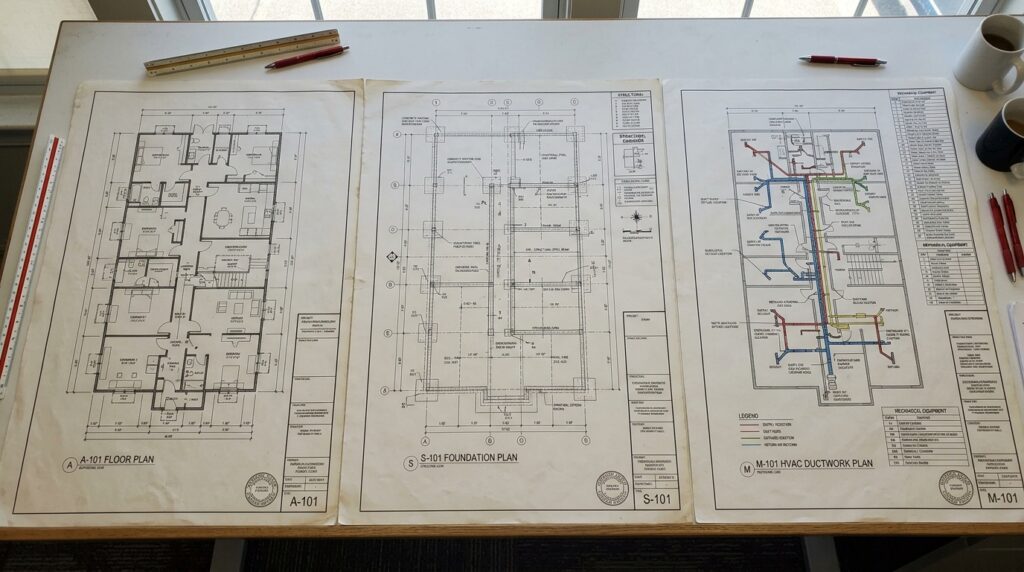
Here’s what you’ll find in most commercial and residential drawing sets:
| Drawing Type | Sheet Prefix | What It Shows | Who Uses It |
| Architectural | A | Floor plans, elevations, sections, room finishes, door/window schedules | GCs, finish contractors, estimators |
| Structural | S | Foundation plans, framing, load paths, steel/concrete details | Structural subs, concrete contractors |
| MEP | M, E, P | HVAC layouts, electrical panels, plumbing risers, fixture schedules | MEP trades, estimators |
| Civil/Site | C | Grading, utilities, paving, drainage, site boundaries | Sitework contractors, excavators |
| Detail Drawings | Various | Enlarged sections, connection details, material assemblies | All trades for specific assemblies |
When you’re preparing a material takeoff from drawings, you’ll cross-reference multiple sheet types. A door schedule on the architectural drawings connects to hardware specs in the specifications book and framing details on the structural sheets. Learn more about quantity takeoff in construction to master this process.
How to Read Construction Drawings for Estimating: Step-by-Step
Reading construction drawings for accurate estimating requires a systematic approach. Skipping steps leads to missed quantities and blown budgets. Follow this process — it’s the same method our estimators use at Phoenix Estimations on every construction takeoff project.
Step 1: Start with the Title Block
Every drawing sheet includes a title block — usually in the bottom right corner. This tells you: project name and address, sheet number and title, drawing scale, revision date and number, and architect/engineer of record.
Check the revision date first. Outdated drawings cause the most expensive estimating errors.
Step 2: Verify the Scale
Scale notation appears in the title block and often again near specific details. Common scales include: 1/4″ = 1′-0″ (floor plans), 1/8″ = 1′-0″ (site plans), and 1″ = 1′-0″ or larger (details).
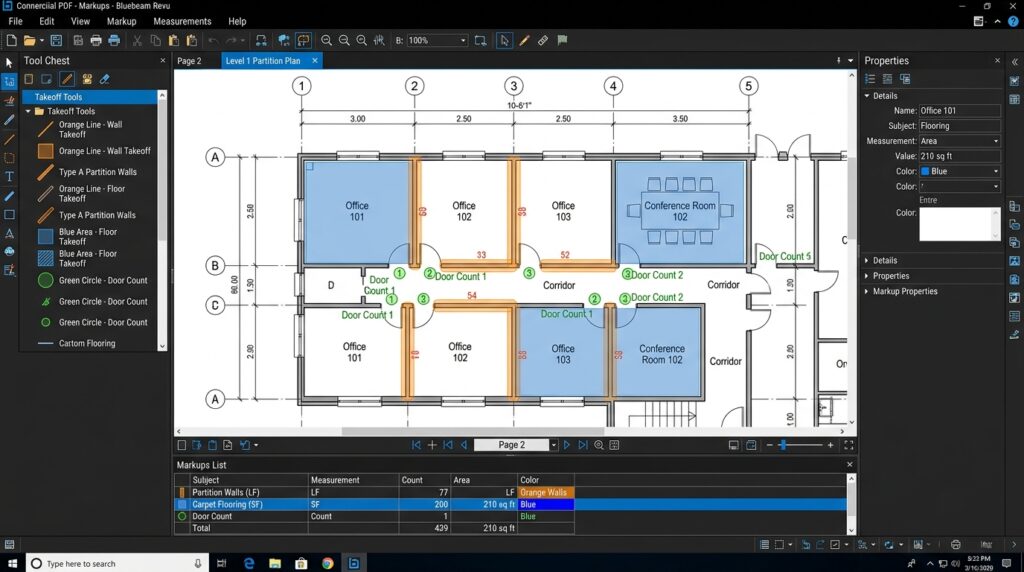
Use an architect’s scale or digital tools like Bluebeam or PlanSwift to measure accurately. Never assume — always verify.
Step 3: Review the Spec Sheet and Drawing Index
The specification book (specs) and drawing index tell you what’s included in the project scope. The specs define material grades, installation methods, and quality standards. The index lists every sheet in the set.
Cross-reference drawings against specs. The drawings show where and how much. The specs tell you what exactly.
Step 4: Identify Trade Scope
Break the drawings into trade-specific sections. For a quantity takeoff process, you’ll measure: concrete volumes and reinforcing, framing lumber and hardware, drywall square footage, flooring and finishes, and MEP rough-in quantities.
Each trade reads different sheets. Electrical estimators focus on E sheets. Concrete contractors need S sheets and civil drawings.
Step 5: Mark Up for Takeoff
Using Bluebeam, PlanSwift, or printed drawings with colored pencils, mark each item as you count it. This prevents double-counting and missed items.
Color-code by material or system. Highlight areas you’ve measured. Note any discrepancies or RFI items.
Don’t have time to work through drawings yourself? Phoenix Estimations handles the full takeoff and cost estimate — trade-by-trade, fast turnaround. Our construction estimating service delivers bid-ready numbers. Get a quote today →
Common Symbols and Abbreviations Every Estimator Must Know
Construction drawings use standardized symbols to communicate information quickly. Misreading a symbol can mean ordering the wrong material or missing an entire scope item.
Here are the 12 symbols and abbreviations you’ll encounter most often:
| Symbol/Abbrev | Meaning | Where You’ll See It |
| ⌀ or DIA | Diameter | Structural, plumbing drawings |
| C/L or ℄ | Centerline | Floor plans, site plans |
| NIC | Not in Contract | All drawings — critical for scope |
| TYP | Typical (applies to similar conditions) | All drawings |
| EQ | Equal spacing | Architectural, structural |
| SIM | Similar to detail shown | Details, sections |
| NTS | Not to Scale | Detail drawings |
| E or EXIST | Existing (not new work) | Renovation drawings |
| N or NEW | New construction | Renovation drawings |
| VIF | Verify in Field | All drawings |
| REV | Revision cloud/triangle | All sheets — indicates changes |
| GWB or GYP | Gypsum wallboard/drywall | Architectural, interior |
Pay special attention to NIC (Not in Contract) and E/EXIST notations. These define what you’re bidding — and what you’re not. Missing an NIC note means pricing work that isn’t yours. Missing EXIST work means pricing demolition someone else handles.
Revision clouds deserve extra attention. In 2025 and 2026, with accelerated project timelines and compressed bid schedules, revisions often arrive late. Always confirm you’re working from the latest set.
Common Drawing Reading Mistakes That Cause Estimating Errors
Even experienced estimators make drawing reading errors. These mistakes don’t just affect your numbers — they affect your profit margin and client relationships. For more on this topic, see our guide to construction estimating mistakes to avoid.
1. Ignoring Revision Clouds
Revision clouds mark changes from previous drawing versions. If you’re working from an outdated PDF or missing the latest addendum, your quantities are wrong before you start.
Fix: Always verify you have the latest revision. Check the title block date against bid documents.
2. Misreading Scale
Assuming 1/4″ scale when the drawing is 1/8″ doubles your quantities. This happens constantly on large commercial projects where floor plans span multiple sheets at different scales.
Fix: Check scale notation on every sheet and at every detail. Use calibrated digital takeoff tools.
3. Missing Spec Notes and General Notes
Drawings reference specifications. General notes on sheet G-001 or A-001 often include scope items not shown graphically — like painting, caulking, or fire-stopping.
Fix: Read general notes completely. Cross-reference spec sections before finalizing quantities.
4. Not Cross-Referencing MEP Drawings
Architectural drawings show walls. MEP drawings show what’s inside them. Missing the electrical panel on the E sheets means missing the backing, conduit, and coordination with drywall.
Fix: Layer MEP over architectural in your takeoff software. Check every trade’s sheets.
5. Overlooking Detail Sheets
Floor plans show general layout. Detail sheets show how things actually get built — jamb details, flashing assemblies, connection hardware. These details often add materials not visible on plans.
Fix: Follow every detail callout. Price what the details show, not just what the plans imply.
These errors cost contractors thousands per project. Our estimators catch them daily. Send us your drawings →
When It Makes Sense to Outsource Drawing Interpretation
Reading construction drawings takes experience. Learning to read construction drawings accurately enough for competitive bidding takes years of practice across multiple project types — restaurants, schools, retail, industrial facilities.
Here’s when outsourcing drawing interpretation to a professional estimating service makes business sense:
You’re bidding multiple projects simultaneously. With labor shortages continuing through 2026, your field team can’t spare time for detailed takeoffs. Professional estimators deliver bid-ready numbers while your crew focuses on production.
The project involves unfamiliar trades or building types. A residential contractor bidding their first commercial restaurant faces new drawing conventions, code requirements, and specification standards.
Bid deadlines are tight. Fast turnaround matters. At Phoenix Estimations, we’ve delivered accurate estimates on projects from Tim Hortons franchise renovations to Lincoln University expansions — often within days of receiving drawings.
Your estimates keep coming in too high or too low. Consistent pricing problems signal a drawing interpretation issue. Fresh eyes catch what you’ve been missing.
This isn’t about capability — it’s about efficiency. Your time has value. If reading drawings takes you away from winning work and managing projects, the math favors outsourcing.
Frequently Asked Questions
Q: What are the different types of construction drawings?
A: Construction drawing sets typically include architectural (A), structural (S), mechanical (M), electrical (E), plumbing (P), and civil/site (C) drawings. Each type communicates specific information to different trades. Architectural drawings show layouts and finishes. Structural drawings show load-bearing elements. MEP drawings show building systems.
Q: How do you read scale on construction drawings?
A: Scale notation appears in the title block and near individual details. Common formats include 1/4″ = 1′-0″ or 1:50 metric. Use an architect’s scale ruler or calibrated digital takeoff software like Bluebeam or PlanSwift. Always verify scale on each sheet — different drawings in the same set often use different scales.
Q: What symbols should every estimator know?
A: Essential symbols include NIC (Not in Contract), TYP (Typical), VIF (Verify in Field), revision clouds, centerline markers, and existing/new work designations. These symbols define scope boundaries and affect quantities. Missing an NIC notation means pricing work outside your contract.
Q: Can AI read construction drawings?
A: AI tools are emerging for construction drawing analysis, but they currently work best as assistants rather than replacements. AI can help with pattern recognition and basic counting, but complex scope interpretation, specification cross-referencing, and trade coordination still require experienced human estimators.
Q: How do drawing errors affect construction estimates?
A: Drawing reading errors directly impact bid accuracy. Misreading scale can double or halve quantities. Missing revision clouds means pricing outdated scope. Overlooking spec notes leads to incomplete material lists. At Phoenix Estimations, we’ve seen single drawing errors cause $50,000+ variances on mid-size commercial projects.
Key Takeaways
• Every construction drawing set contains architectural, structural, MEP, and civil drawings — each tells you different information for your estimate
• Follow a systematic process: title block → scale → specs → trade scope → markup for takeoff
• Learn the critical symbols: NIC, TYP, VIF, and revision clouds directly affect your bid accuracy
• Common mistakes include ignoring revisions, misreading scale, and skipping MEP cross-references — each costs real money
• Outsourcing drawing interpretation makes sense when speed, accuracy, or unfamiliar project types are factors — Phoenix Estimations delivers trade-by-trade takeoffs with fast turnaround
Ready for Accurate Estimates Without the Drawing Headaches?
Reading construction drawings takes experience. If you want estimates done right — without pulling your team off productive work — Phoenix Estimations is ready.
We’ve delivered accurate, trade-specific estimates and detailed quantity takeoffs for 2,000+ projects across residential, commercial, and industrial sectors in the US and Canada. Our turnaround times match your bid schedule.
👉 Request a Construction Estimate
👉 Get a Professional Quantity Takeoff
Contact us for a free consultation →
Conclusion
Knowing how to read construction drawings accurately is foundational to every successful estimate and bid. The contractors who win work — and protect their margins — treat drawing interpretation as a skill worth mastering or outsourcing to experts.
Whether you’re learning to read construction drawings yourself or partnering with a professional estimating team, the goal is the same: accurate quantities, realistic budgets, and bids you can stand behind.
What’s the toughest drawing set you’ve had to estimate? The complexity of modern construction only increases. Your approach to reading those drawings determines whether that complexity costs you — or your competition.
Resources
• Construction Specifications Institute (CSI) — CSI MasterFormat standards for construction documentation
• AACE International — Cost engineering and estimating best practices
• RS Means / Gordian — Industry-standard cost data and estimating references
• American Institute of Architects — Drawing standards and architectural documentation guidelines
• National Institute of Building Sciences — Building information and construction standards
About the Author
Phoenix Estimations Editorial Team
This article was written by the estimating professionals at Phoenix Estimations — a construction cost estimating company with 8 years of experience, 2,000+ completed projects, and 4,000+ satisfied clients across the United States and Canada. Our team includes certified estimators with backgrounds in general contracting, subcontracting, and project management across residential, commercial, and industrial sectors. We use industry-leading tools including Bluebeam, PlanSwift, RSMeans, and Autodesk Takeoff to deliver accurate, bid-ready estimates