
Construction projects are complex. Cost overruns can significantly erode profitability and delay completion. In fact, industry reports often cite projects exceeding budgets by 10-15% or more due to unforeseen issues or inefficient planning. Understanding how to estimate construction costs accurately is the first step, but proactive cost management is crucial. This is precisely where what is value engineering in construction becomes indispensable.
At Phoenix Estimations, with over 2,000 completed projects and 4,000+ satisfied clients across the US and Canada, we have seen firsthand what accurate estimating does for project outcomes. We understand the critical role of strategic cost optimization. This guide will clarify the value engineering process, its benefits, and how it directly leads to significant cost savings without compromising project quality or function.
TL;DR: Value Engineering Essentials
- Core Insight: Value engineering (VE) is a systematic, organized approach to optimizing a project’s functional value relative to its cost.
- Key Process: It involves a multidisciplinary team conducting functional analysis, identifying alternative solutions, and evaluating life cycle costs.
- Primary Benefit: VE maximizes project value by eliminating unnecessary costs while maintaining or enhancing performance and quality.
- Action Step: Phoenix Estimations provides the precise, data-backed estimates essential for effective VE implementation and decision-making.
Table of Contents
- What Is Value Engineering in Construction?
- Why Value Engineering Matters for Your Project
- How to Implement the Value Engineering Process Step-by-Step
- Tools and Methods for Effective Value Engineering
- Real-World Example — How Phoenix Estimations Solved It
- Common Value Engineering Mistakes to Avoid
- Benefits of Professional Value Engineering Services
- FAQ Section
- Key Takeaways
What Is Value Engineering in Construction?
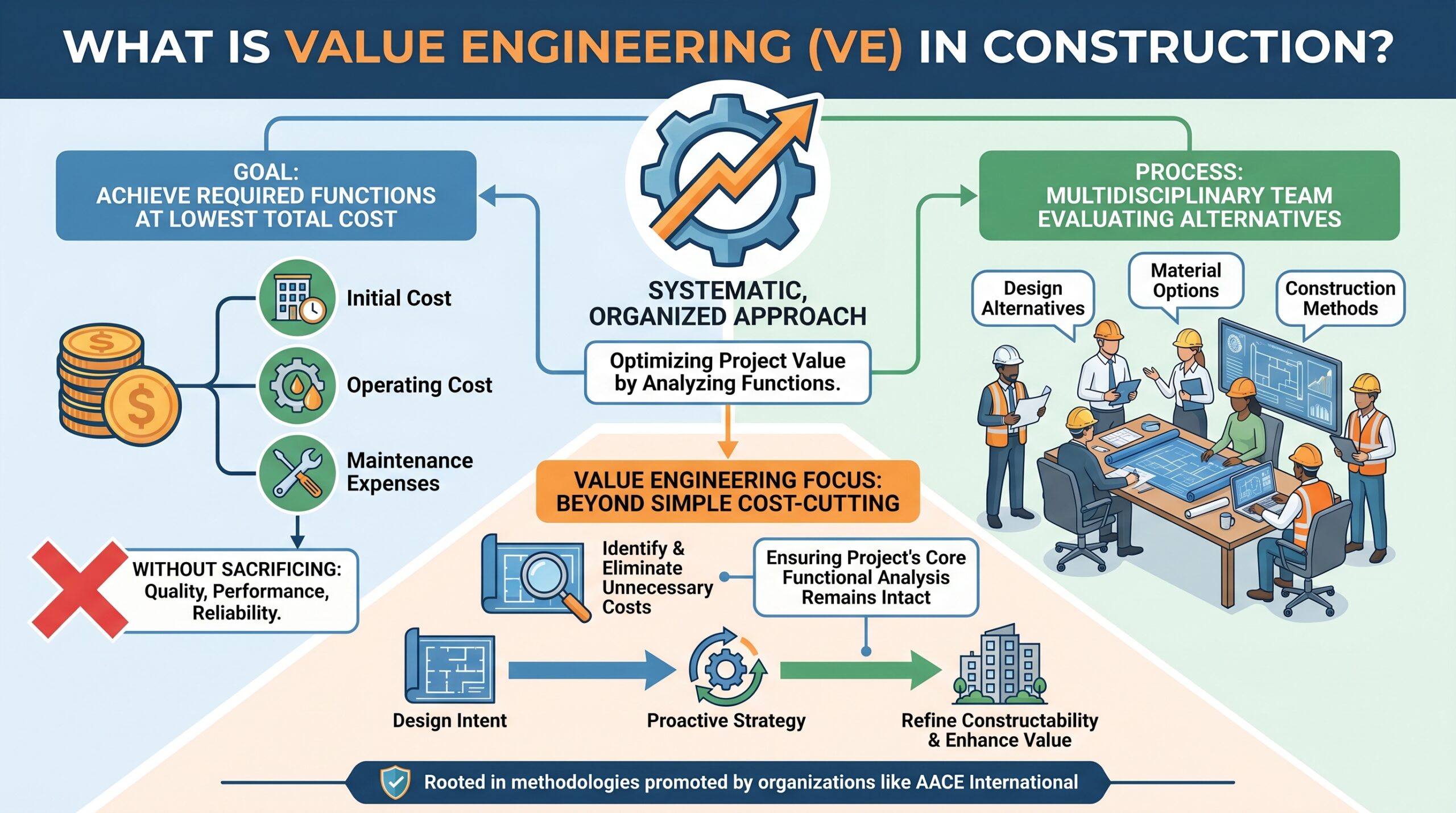
Value engineering (VE) in construction is a systematic, organized approach to optimizing the value of a project by analyzing its functions. It aims to achieve the required functions at the lowest total cost, including initial, operating, and maintenance expenses, without sacrificing quality, performance, or reliability. This process often involves a multidisciplinary team evaluating design alternatives.
Rooted in methodologies promoted by organizations like AACE International, value engineering focuses on enhancing project value. It goes beyond simple cost-cutting. VE seeks to identify and eliminate unnecessary costs while ensuring the project’s core functional analysis remains intact. It’s a proactive strategy applied throughout the project lifecycle to refine design intent and constructability.
Why Value Engineering Matters for Your Project
In today’s competitive construction landscape, every dollar counts. Value engineering offers a proven pathway to substantial construction cost reduction, often saving projects anywhere from 5% to 15% of their total budget. By 2025, proactive value engineering will be a standard expectation for most major projects, driving efficiency and innovation.
- Cost Control: VE identifies alternative materials construction, systems, or methods that reduce costs without compromising performance. This directly impacts your cost estimating service accuracy.
- Schedule Adherence: By optimizing designs and processes, VE can streamline construction, preventing delays and keeping projects on track.
- Risk Mitigation: Early identification of potential issues and evaluation of alternative solutions reduces project risks, improving long-term viability.
- Improved Quality & Performance: Sometimes, VE even identifies solutions that enhance quality or operational efficiency while lowering costs.
- Competitive Bidding: A well-value-engineered project allows for more competitive bids, increasing your chances of winning contracts.
- Enhanced Client Relationships: Delivering projects on budget and on time fosters trust and repeat business.
Struggling with estimate accuracy? Our construction estimating service at https://phoenixestimations.com/construction-estimating-service delivers bid-ready numbers fast.
How to Implement the Value Engineering Process Step-by-Step
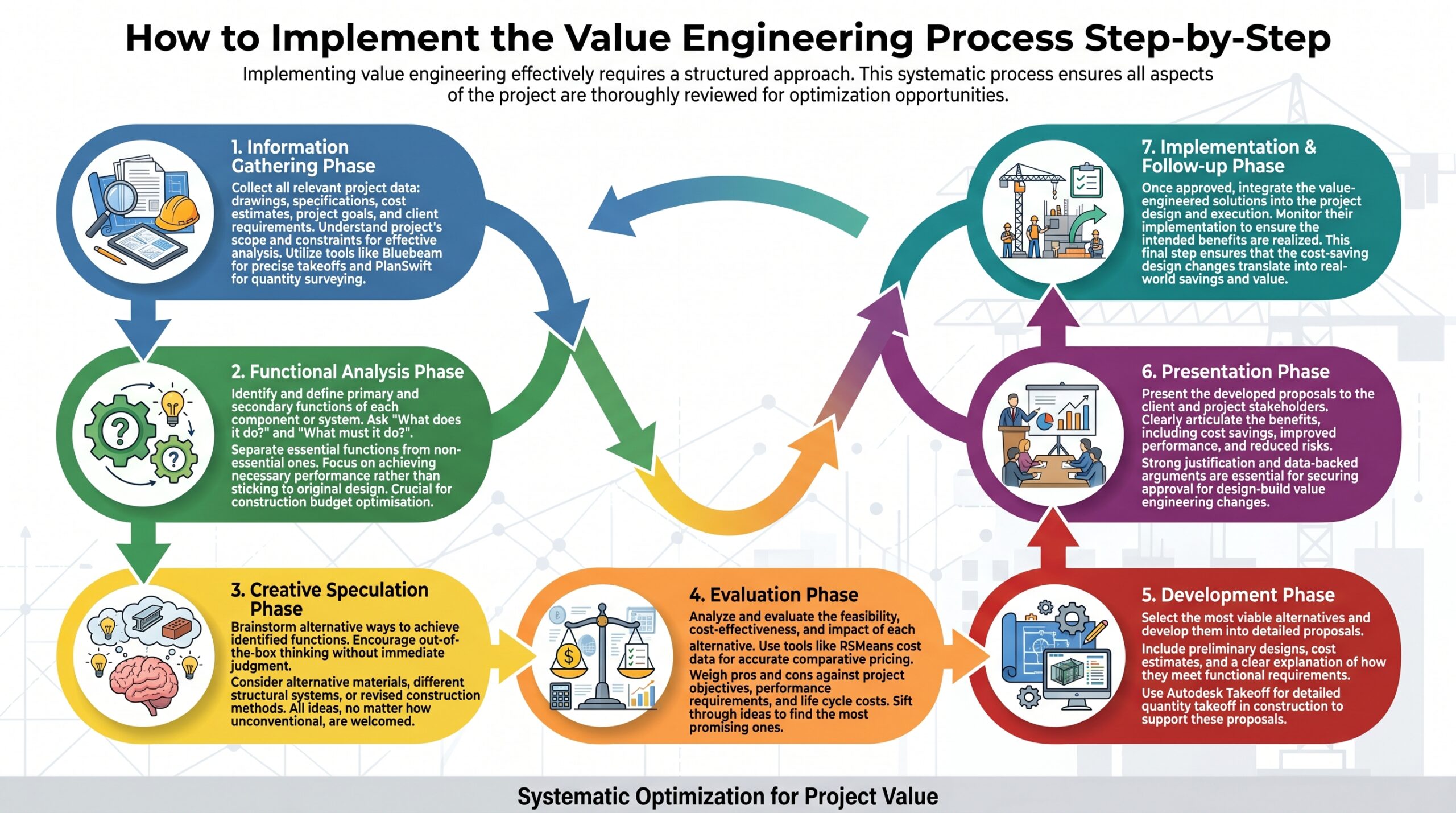
Implementing value engineering effectively requires a structured approach. This systematic process ensures all aspects of the project are thoroughly reviewed for optimization opportunities. Here’s how the value engineering process typically unfolds:
-
Information Gathering Phase
Collect all relevant project data. This includes drawings, specifications, cost estimates, project goals, and client requirements. Understanding the project’s scope and constraints is critical for effective analysis. Utilize tools like Bluebeam for precise takeoffs and PlanSwift for quantity surveying.
-
Functional Analysis Phase
Identify and define the primary and secondary functions of each component or system. Ask “What does it do?” and “What must it do?” This phase separates essential functions from non-essential ones. It helps focus on achieving necessary performance rather than sticking to original design. This is crucial for identifying areas for construction budget optimisation.
-
Creative Speculation Phase
Brainstorm alternative ways to achieve the identified functions. Encourage out-of-the-box thinking without immediate judgment. Consider alternative materials construction, different structural systems, or revised construction methods. All ideas, no matter how unconventional, are welcomed at this stage.
-
Evaluation Phase
Analyze and evaluate the feasibility, cost-effectiveness, and impact of each alternative. Use tools like RSMeans cost data for accurate comparative pricing. Weigh the pros and cons against project objectives, performance requirements, and life cycle costs. This stage sifts through the creative ideas to find the most promising ones.
-
Development Phase
Select the most viable alternatives and develop them into detailed proposals. This includes preliminary designs, cost estimates, and a clear explanation of how they meet functional requirements. Use Autodesk Takeoff for detailed quantity takeoff in construction to support these proposals.
-
Presentation Phase
Present the developed proposals to the client and project stakeholders. Clearly articulate the benefits, including cost savings, improved performance, and reduced risks. Strong justification and data-backed arguments are essential for securing approval for design-build value engineering changes.
-
Implementation & Follow-up Phase
Once approved, integrate the value-engineered solutions into the project design and execution. Monitor their implementation to ensure the intended benefits are realized. This final step ensures that the cost-saving design changes translate into real-world savings and value.
Tools and Methods for Effective Value Engineering
Effective value engineering relies on robust data, advanced software, and a collaborative approach. Modern construction estimating software significantly enhances the efficiency and accuracy of the VE process, allowing for rapid analysis of alternative solutions.
- Bluebeam: Essential for precise digital takeoffs and collaborative document review, allowing teams to quickly mark up and analyze drawings for VE opportunities.
- PlanSwift: Provides powerful on-screen takeoff capabilities, enabling rapid quantification of materials for different design alternatives. This is crucial for comparing costs.
- Procore: A comprehensive construction management platform that facilitates collaboration, document control, and cost tracking, supporting the overall VE process from planning to implementation.
- RSMeans: An industry-standard cost database providing reliable, localized cost data for materials, labor, and equipment. This is invaluable for accurately comparing the cost implications of various VE proposals.
- Autodesk Takeoff: Offers advanced 2D and 3D takeoff functionalities, supporting detailed quantity extraction for complex projects and facilitating ‘what-if’ scenarios in VE.
Comparison: Manual vs. Digital/Software Methods in VE
| Factor | Manual Method | Digital/Software Method |
|---|---|---|
| Speed | Slow, labor-intensive | Fast, automated calculations |
| Accuracy | Prone to human error | High, consistent, data-driven |
| Cost | High labor cost for analysis | Initial software investment, lower long-term labor cost |
| Scalability | Limited by team size | Highly scalable for large projects |
| Audit Trail | Difficult to track changes | Comprehensive digital records and version control |
Real-World Example — How Phoenix Estimations Solved It
At Phoenix Estimations, our expertise in detailed commercial estimating services and quantity takeoffs directly supports effective value engineering for our clients. We empower them to make informed decisions that optimize project value.
Case Study 1: Lincoln University Exterior Finishes
A university project faced budget constraints for its new academic building’s exterior finishes. Our team provided precise material takeoffs using Bluebeam and PlanSwift. We then collaborated with the client to explore alternative materials that met aesthetic and performance requirements but at a lower cost. Our accurate data-backed estimates enabled the project team to identify value-engineered solutions that significantly reduced waste and kept the project within budget without compromising the architectural design intent. This strategic intervention saved the client substantial costs while maintaining the building’s integrity.
Case Study 2: Crunch Fitness California Interior Finishes
For a Crunch Fitness gym renovation in California, the client encountered potential interior finishes budget overruns early in the design phase. Our detailed residential estimating services (applicable to commercial interiors as well) quickly identified the primary cost drivers. By providing an updated estimate with value-engineered options for flooring, wall treatments, and lighting, we helped the client explore alternative materials and finishes. This allowed them to align the final selection with the design intent while restoring full budget control, preventing costly changes down the line.
Common Value Engineering Mistakes to Avoid
While value engineering offers immense benefits, several pitfalls can undermine its effectiveness. Avoiding these common errors is crucial for successful construction budget optimisation.
- Late Implementation: Waiting until design is finalized severely limits opportunities for significant cost-saving design changes. VE is most effective early in the design phase, before major commitments are made.
- Focusing Solely on Initial Cost: True VE considers life cycle costs, including operation, maintenance, and disposal. Ignoring these can lead to higher long-term expenses, defeating the purpose.
- Sacrificing Quality or Function: Value engineering is not about cheapening the project. It’s about achieving the required function and quality at the best possible cost. Compromising these aspects leads to project failure and client dissatisfaction.
- Lack of Stakeholder Buy-in: Without the full support and participation of all key stakeholders—owners, architects, engineers, contractors—VE proposals can face resistance and fail to be implemented.
- Inadequate Data or Analysis: Basing decisions on incomplete or inaccurate data leads to flawed conclusions. Thorough research, precise takeoffs, and reliable cost data (like RSMeans) are non-negotiable.
- Poor Communication: Clear and consistent communication among the VE team and with all project stakeholders is vital. Misunderstandings can derail the process and prevent successful implementation of good ideas.
Benefits of Professional Value Engineering Services
Engaging professional estimating firms for value engineering support offers distinct advantages. These services provide the specialized expertise and objective analysis necessary to unlock significant project value.
- Enhanced ROI: Professional VE identifies opportunities to reduce capital expenditure and operational costs, directly improving your project’s return on investment.
- Reduced Risk: Expert analysis helps mitigate financial and schedule risks by proactively addressing potential issues and offering robust alternatives.
- Time Savings: An experienced team can conduct comprehensive VE studies efficiently, delivering actionable insights without delaying the project timeline.
- Improved Bid Win Rates: Projects optimized through VE can be tendered more competitively, increasing your chances of securing profitable contracts.
- Objective Perspective: External experts bring a fresh, unbiased viewpoint, often identifying solutions internal teams might overlook due to familiarity or existing biases.
At Phoenix Estimations, our team of seasoned estimators leverages advanced software and extensive industry knowledge to provide the precise data and insights required for effective value engineering. We help general contractors, subcontractors, developers, and project owners across the US and Canada achieve superior project outcomes through smart, data-driven decisions.
FAQ Section
- What is the difference between value engineering and cost cutting?
- Value engineering is a systematic process focused on optimizing function and value relative to cost, often enhancing quality. Cost cutting, conversely, typically aims to reduce expenses without necessarily considering the impact on functionality, quality, or long-term value. VE is strategic; cost cutting can be reactive.
- When is the best time to apply value engineering in a construction project?
- The most effective time to apply value engineering is during the early design phases, ideally before 30% design completion. This allows for maximum flexibility to implement changes without incurring significant redesign costs or schedule delays, maximizing potential savings and value. Our preliminary estimating services can support this phase.
- Who is typically involved in a value engineering study?
- A multidisciplinary team typically conducts a VE study. This includes the owner, architect, engineers (structural, mechanical, electrical), general contractor, and specialized consultants. Their diverse perspectives ensure a comprehensive review and identification of optimal solutions.
- How does Phoenix Estimations support value engineering efforts?
- Phoenix Estimations provides precise, data-backed construction estimating service and quantity takeoffs. Our detailed cost breakdowns and analysis of alternative materials and systems give clients the critical information needed to make informed value engineering decisions, ensuring accuracy and efficiency in their projects.
- What are some common examples of value engineering in construction?
- Common examples include optimizing structural systems (e.g., prefabrication, alternative concrete mixes), selecting more cost-effective but equally durable exterior finishes, rationalizing MEP systems for energy efficiency, or simplifying complex architectural details. These changes aim to deliver equivalent or better performance at a lower life cycle cost.
Key Takeaways
- Most Important Insight: Value engineering is a proactive, strategic process for optimizing project value and function, distinct from simple cost-cutting.
- Actionable Step: Integrate a systematic value engineering process early in your project’s design phase to unlock maximum savings and efficiency.
- Business Risk If Ignored: Without VE, projects risk budget overruns, missed opportunities for innovation, and suboptimal long-term performance.
- How Phoenix Estimations Addresses This Need: We provide the precise, data-driven estimates and quantity takeoffs essential for informed value engineering decisions, ensuring your projects achieve optimal value.
Need Accurate Estimates for Your Value Engineering Initiatives?
Facing tight budgets or needing to optimize project spending? Don’t let uncertainty impact your project’s profitability. At Phoenix Estimations, we have delivered accurate trade-specific construction estimates and detailed quantity takeoffs for 2,000+ projects across residential, commercial, and industrial sectors in the US and Canada — with turnaround times that match your bid schedule. Leverage our expertise for your next project.
Conclusion
Understanding what is value engineering in construction is paramount for any project aiming for efficiency and profitability. It’s more than just cutting costs; it’s a strategic process that enhances a project’s functional value by systematically identifying and eliminating unnecessary expenditures throughout its lifecycle. By adopting a structured VE approach, construction professionals can optimize designs, select smarter materials, and streamline processes, ultimately delivering superior projects within budget and on schedule.
At Phoenix Estimations, our commitment is to provide the precise, data-driven estimating and takeoff services you need to implement effective value engineering. We empower general contractors, developers, and project owners to make informed decisions that lead to significant savings and enhanced project outcomes. Partner with us to ensure your next construction venture achieves its maximum potential value.