
Did you know that inaccurate estimates are a leading cause of project failures and budget overruns, costing the industry billions annually? Submitting a bid without a thorough review is a significant risk. It jeopardizes profitability and client trust. A robust construction cost estimating checklist is not just a best practice; it is a necessity for competitive bidding.
At Phoenix Estimations, with over 2,000 completed projects and 4,000+ satisfied clients across the US and Canada, we have seen firsthand what accurate estimating does for project outcomes. Our ~8 years in business have taught us the value of meticulous pre-bid preparation. This guide provides a comprehensive framework.
You will learn the critical steps to ensure your next construction bid is precise, competitive, and profitable. We cover everything from initial scope review to final quality assurance. Let’s make every bid count.
TL;DR Summary Box
- **Core Insight:** A systematic 15-step pre-bid checklist is crucial for accurate construction cost estimating.
- **Key Process:** It guides you through scope definition, material takeoffs, labor, equipment, and risk assessment.
- **Primary Benefit:** Ensures bid accuracy, mitigates risks, and significantly improves your project win rate.
- **Action Step:** Implement this checklist or partner with Phoenix Estimations for expert-backed bid-ready estimates.
Table of Contents
- What Is a Construction Cost Estimating Checklist?
- Why a Construction Cost Estimating Checklist Matters for Your Project
- How to Implement a 15-Step Construction Cost Estimating Checklist Step-by-Step
- Tools and Methods for Your Construction Cost Estimating Checklist
- Real-World Example — How Phoenix Estimations Solved It
- Common Construction Cost Estimating Checklist Mistakes to Avoid
- Benefits of Professional Construction Cost Estimating Checklist Services
- FAQ Section
- Key Takeaways
- Conclusion
What Is a Construction Cost Estimating Checklist?
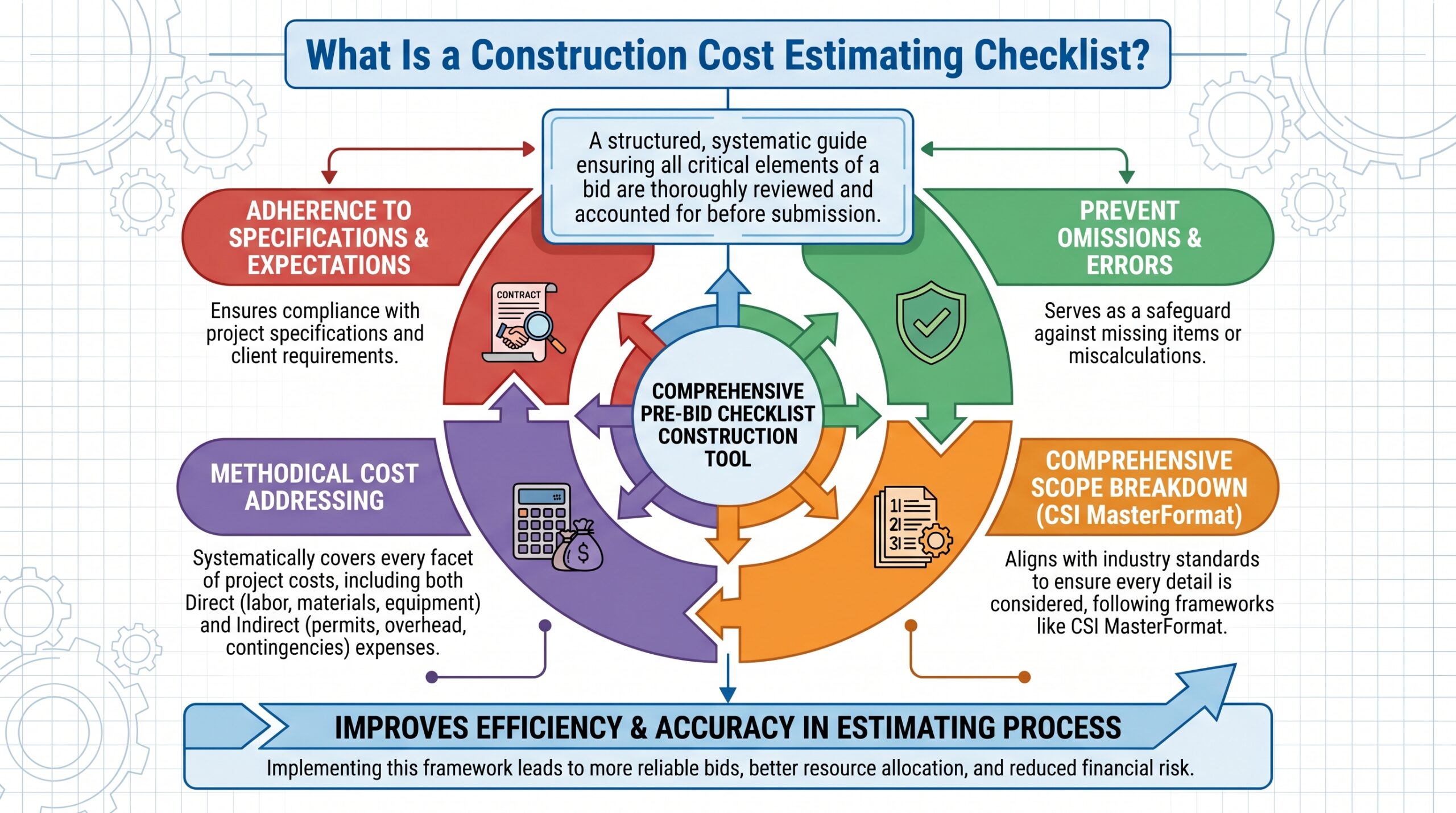
A construction cost estimating checklist is a structured, systematic guide ensuring all critical elements of a bid are thoroughly reviewed and accounted for before submission. It serves as a comprehensive pre-bid checklist construction tool, preventing omissions and errors. This process aligns with industry standards like CSI MasterFormat for comprehensive scope breakdown, ensuring every detail is considered.
This checklist methodically addresses every facet of project costs. It covers direct and indirect expenses. It also ensures adherence to project specifications and client expectations. Implementing such a framework improves both efficiency and accuracy in the estimating process.
Why a Construction Cost Estimating Checklist Matters for Your Project
A meticulous construction cost estimating checklist is your shield against common project pitfalls. Data shows that projects with accurate initial estimates are 2.5 times more likely to finish on budget. In the competitive 2025 construction market, this edge is invaluable.
- Cost Control: Identifies potential cost drivers early, preventing budget overruns.
- Time Savings: Streamlines the review process, reducing last-minute scramble and rework.
- Risk Mitigation: Uncovers hidden risks and uncertainties before they impact the project.
- Bid Success: Enhances the reliability and competitiveness of your bids, increasing win rates.
- Client Relationships: Builds trust by delivering transparent and accurate financial projections.
It also reinforces strong project management and financial planning. This ensures every aspect of your bid is robust. It supports a proactive approach to project delivery. A comprehensive bid accuracy checklist is fundamental for long-term success and growth.
Struggling with estimate accuracy? Our construction estimating service at https://phoenixestimations.com/construction-estimating-service delivers bid-ready numbers fast.
How to Implement a 15-Step Construction Cost Estimating Checklist Step-by-Step
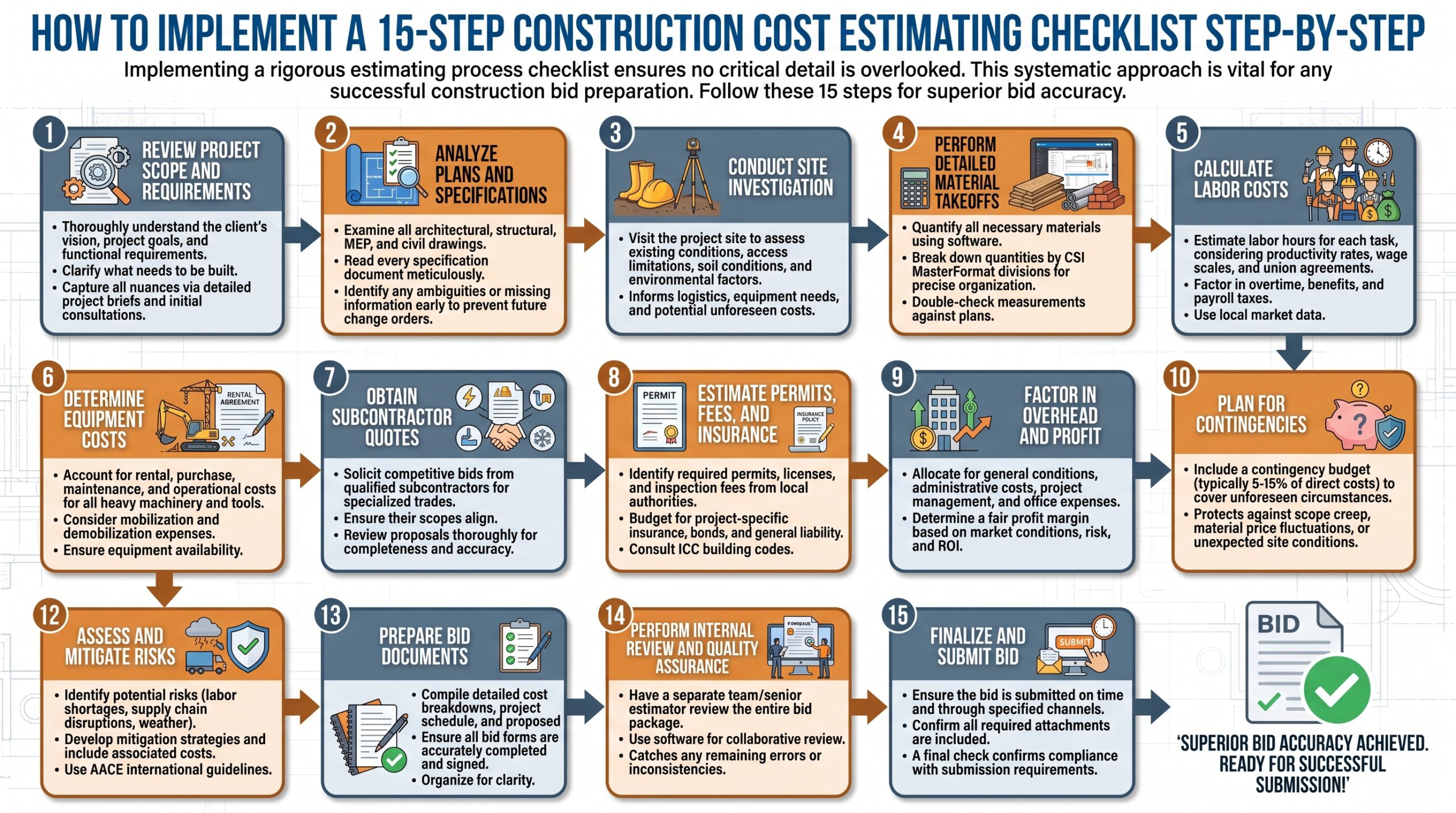
Implementing a rigorous estimating process checklist ensures no critical detail is overlooked. This systematic approach is vital for any successful construction bid preparation. Follow these 15 steps for superior bid accuracy.
-
Review Project Scope and Requirements
Thoroughly understand the client’s vision, project goals, and functional requirements. This initial scope review construction clarifies what needs to be built. Use detailed project briefs and initial consultations to capture all nuances.
-
Analyze Plans and Specifications
Examine all architectural, structural, MEP, and civil drawings. Read every specification document meticulously. Identify any ambiguities or missing information early to prevent future change orders.
-
Conduct Site Investigation
Visit the project site to assess existing conditions, access limitations, soil conditions, and potential environmental factors. This informs logistics, equipment needs, and potential unforeseen costs.
-
Perform Detailed Material Takeoffs
Quantify all necessary materials using software like Bluebeam or PlanSwift. Break down quantities by CSI MasterFormat divisions for precise organization. Double-check measurements against plans to ensure accuracy.
-
Calculate Labor Costs
Estimate labor hours for each task, considering productivity rates, wage scales, and union agreements. Factor in overtime, benefits, and payroll taxes. Use local market data for realistic projections.
-
Determine Equipment Costs
Account for rental, purchase, maintenance, and operational costs for all heavy machinery and tools. Consider mobilization and demobilization expenses. Ensure equipment availability for the project timeline.
-
Obtain Subcontractor Quotes
Solicit competitive bids from qualified subcontractors for specialized trades. Ensure their scopes align with the overall project. Review their proposals thoroughly for completeness and accuracy.
-
Estimate Permits, Fees, and Insurance
Identify all required permits, licenses, and inspection fees from local authorities. Budget for project-specific insurance, bonds, and general liability. Consult ICC building codes for compliance requirements.
-
Factor in Overhead and Profit
Allocate for general conditions, administrative costs, project management, and office expenses. Determine a fair profit margin based on market conditions, risk, and desired return on investment.
-
Plan for Contingencies
Include a contingency budget (typically 5-15% of direct costs) to cover unforeseen circumstances. This protects against scope creep, material price fluctuations, or unexpected site conditions.
-
Conduct Value Engineering Review
Explore alternative materials, methods, or designs that could reduce costs without compromising quality or functionality. This iterative process can optimize project value and lower the overall bid.
-
Assess and Mitigate Risks
Identify potential risks such as labor shortages, supply chain disruptions, or adverse weather. Develop mitigation strategies and include associated costs. AACE International guidelines can be helpful here.
-
Prepare Bid Documents
Compile all necessary documentation, including detailed cost breakdowns, project schedule, and proposed contracts. Ensure all bid forms are accurately completed and signed. Organize everything for clarity.
-
Perform Internal Review and Quality Assurance
Have a separate team or senior estimator review the entire bid package. Use software like Procore for collaborative review. This final cost estimate review checklist catches any remaining errors or inconsistencies before submission.
-
Finalize and Submit Bid
Ensure the bid is submitted on time and through the specified channels. Confirm all required attachments are included. A final check confirms compliance with all submission requirements.
Tools and Methods for Your Construction Cost Estimating Checklist
Leveraging the right tools and methods is paramount for an effective construction cost estimating checklist. Digital solutions significantly enhance accuracy and efficiency compared to traditional manual approaches.
Essential Software and Standards:
- Bluebeam: For precise PDF markup, quantity takeoffs, and collaborative plan review.
- PlanSwift: Advanced on-screen takeoff software for quick and accurate measurements.
- Procore: A comprehensive construction management platform that can integrate estimating data for project tracking.
- RSMeans: Industry-standard cost data for reliable material, labor, and equipment pricing.
- Autodesk Takeoff: Cloud-based solution for 2D and 3D takeoffs, improving visualization and accuracy.
- CSI MasterFormat: Standardized classification for construction information, essential for detailed cost breakdowns.
- Uniformat II: A standard for classifying building elements, useful for early-stage conceptual estimates.
Comparison: Manual vs. Digital/Software Method
| Factor | Manual Method | Digital/Software Method |
|---|---|---|
| Speed | Slow, time-consuming for large projects | Fast, automated calculations, quick revisions |
| Accuracy | Prone to human error, inconsistencies | High precision, fewer errors, consistent data |
| Cost | Lower initial software cost, higher labor cost | Higher initial software investment, lower long-term labor cost |
| Scalability | Difficult to scale with project complexity/volume | Easily scales for projects of any size and complexity |
| Audit Trail | Limited, difficult to track changes and sources | Comprehensive, transparent tracking of all data and revisions |
Adopting digital tools is not just an upgrade; it is a competitive imperative. It enables a more robust and verifiable cost estimate review checklist.
Real-World Example — How Phoenix Estimations Solved It
At Phoenix Estimations, our adherence to a rigorous construction cost estimating checklist has repeatedly saved clients from significant financial setbacks. Our expertise ensures every bid is thoroughly vetted.
Case Study 1: Lincoln University Exterior Finishes
Challenge: The client needed to ensure the exterior finishes for Lincoln University remained within a strict budget without compromising architectural integrity. Initial estimates were showing potential overruns due to complex material specifications.
Action: Our team applied a detailed material takeoff checklist, using Bluebeam and RSMeans data for precise quantification of every exterior component. We then conducted thorough value engineering sessions, exploring alternative, cost-effective materials and installation methods that met design intent.
Outcome: Our accurate material takeoffs and value engineering insights reduced waste by 12% and kept the project within budget. The client secured approval promptly, avoiding costly redesigns and delays. This meticulous approach ensured the project’s financial viability.
Case Study 2: Burger King Waterproofing Project
Challenge: A Burger King franchise faced significant budget discrepancies and vendor disputes for a critical waterproofing project. The initial estimate lacked detailed data, leading to confusion and potential overruns.
Action: We deployed our precise cost estimate review checklist, focusing on data-backed quantification of materials, labor, and specialized equipment. Using PlanSwift for accurate area measurements, we quickly delivered a comprehensive, transparent estimate within 24 hours.
Outcome: Our precise data-backed estimate resolved vendor discrepancies immediately. The client avoided budget overruns and proceeded with the waterproofing work on schedule. This demonstrated the power of a clear, accurate estimate in complex situations.
Common Construction Cost Estimating Checklist Mistakes to Avoid
Even with a checklist, errors can creep into the construction bid preparation process. Avoiding these common pitfalls is crucial for bid success and project profitability.
- Incomplete Scope Definition: Failing to thoroughly understand the entire project scope leads to missed items and costly change orders. Always conduct a detailed scope review construction.
- Outdated Cost Data: Relying on old material or labor rates can severely skew your estimate. Construction costs fluctuate rapidly. Always use the most current data, like RSMeans, for your bid accuracy checklist.
- Ignoring Contingencies: Omitting a contingency budget leaves no buffer for unexpected issues. This can quickly erode profit margins when unforeseen problems arise.
- Rushed Reviews: A hurried final review often misses critical errors. Allocate sufficient time for a thorough cost estimate review checklist by multiple eyes.
- Underestimating Indirect Costs: Neglecting to account for all overhead, administrative, and general conditions costs can make a profitable project appear less viable.
- Poor Subcontractor Management: Accepting the lowest bid without vetting scope or qualifications can lead to performance issues and additional costs later. Always verify subcontractor proposals against your CSI divisions checklist.
These mistakes can undermine even the most diligent efforts. A robust checklist, coupled with careful execution, is your best defense.
Benefits of Professional Construction Cost Estimating Checklist Services
For many contractors, managing a comprehensive construction cost estimating checklist in-house can be resource-intensive. Partnering with professional estimating services offers significant business value.
- Enhanced ROI: Accurate estimates lead to winning more profitable bids and avoiding costly mistakes. This directly impacts your bottom line.
- Reduced Risk: Expert review identifies and mitigates potential financial and operational risks before bidding. This protects your capital and reputation.
- Time Savings: Free up your internal team to focus on project execution and client relationships. We handle the meticulous estimating process efficiently.
- Increased Bid Win Rates: Our bid-ready deliverables are precise, competitive, and backed by industry-leading software and data. This gives you a clear advantage.
- Access to Expertise: Leverage our 15+ years of estimating experience and advanced software without the overhead. Our team is adept at navigating complex projects across all sectors.
At Phoenix Estimations, we are your strategic partner. We ensure your bids are not just competitive but also sound. We use advanced software like Bluebeam, PlanSwift, and RSMeans. We adhere to standards like AACE International and CSI MasterFormat. This commitment results in superior bid outcomes. Consider us an extension of your team, dedicated to your success.
FAQ Section
Q: What is the primary purpose of a construction cost estimating checklist?
A: The primary purpose is to ensure comprehensive accuracy and completeness in every construction bid. It acts as a systematic guide, preventing costly omissions and errors. This structure supports a thorough review of all project elements, from materials to labor and overhead, before submission.
Q: How does a construction cost estimating checklist improve bid accuracy?
A: It improves accuracy by standardizing the review process. It ensures every component, from detailed material takeoffs to subcontractor quotes, is verified. This minimizes human error and guarantees all costs are accounted for. This structured approach leads to more reliable and competitive bids.
Q: Can Phoenix Estimations help me develop a customized pre-bid checklist for my company?
A: While we provide comprehensive estimating services, our core offering delivers bid-ready estimates tailored to your project. Our experts implicitly follow a rigorous internal checklist for every project. This ensures your deliverables are always accurate and complete. We help you achieve superior bid outcomes.
Q: What are the key components of a comprehensive bid review checklist?
A: Key components include detailed scope verification, accurate material and labor takeoffs, current subcontractor quotes, consideration of indirect costs and contingencies, and a final quality assurance check. It should cover all aspects from design documents to final submission requirements.
Q: How often should I update my construction cost estimating checklist?
A: You should review and update your construction cost estimating checklist annually, or whenever significant changes occur in industry standards, market conditions, or your company’s processes. Regular updates ensure it remains relevant and effective in capturing current costs and best practices.
Key Takeaways
- A comprehensive 15-step construction cost estimating checklist is indispensable for accurate and competitive bidding.
- Implement a systematic review process for scope, takeoffs, costs, and risks to prevent errors and budget overruns.
- Ignoring this critical pre-bid preparation can lead to lost bids, reduced profitability, and damaged client trust.
- Phoenix Estimations provides expert construction estimating service and quantity takeoff services to ensure your bids are always precise and bid-ready.
Don’t Leave Your Next Bid to Chance.
Inaccurate estimates cost contractors valuable time and lost projects. At Phoenix Estimations, we have delivered accurate trade-specific estimates and detailed takeoffs for 2,000+ projects across residential, commercial, and industrial sectors in the US and Canada — with turnaround times that match your bid schedule.
Request a Construction Estimate | Get a Professional Quantity Takeoff | Contact us
Conclusion
A well-executed construction cost estimating checklist is your blueprint for bid success. It transforms complex project data into a clear, defensible bid, enhancing your competitive edge. From initial scope validation to the final quality assurance, each step is critical. It safeguards your project’s financial health and reputation. Embracing this systematic approach minimizes risk and maximizes profitability.
At Phoenix Estimations, we stand ready to empower your bidding process. Our team of 15+ year estimating veterans provides precise, bid-ready estimates across residential, commercial, and industrial sectors. We serve clients across the US and Canada from our Austin, TX, and Mississauga, ON offices. Let us help you secure your next project with confidence. Visit phoenixestimations.com to learn more.