
An inaccurate concrete takeoff can cost a project thousands, even tens of thousands, in wasted materials or costly delays. For contractors and developers, underestimating concrete quantities leads to frustrating project slowdowns and budget overruns, while overestimating ties up capital in excess material. At Phoenix Estimations, with over 2,000 completed projects and 4,000+ satisfied clients across the US and Canada, we have seen firsthand what accurate estimating does for project outcomes. This guide on concrete takeoff for beginners will equip you with the fundamental knowledge to measure and calculate concrete quantities precisely, ensuring your next project stays on budget and on schedule. We’ll cover everything from basic volume calculations to essential waste factors.
TL;DR Summary
- Core Insight: Accurate concrete takeoff is crucial for budget control and project efficiency.
- Key Process: Learn step-by-step methods for calculating concrete volume for slabs, footings, and other elements.
- Primary Benefit: Minimize material waste, avoid costly delays, and improve bid accuracy.
- Action Step: Phoenix Estimations provides expert concrete takeoff services for precise project planning.
Table of Contents
- What Is Concrete Takeoff for Beginners?
- Why Accurate Concrete Quantity Calculation Matters for Your Project
- How to Calculate Concrete Volume Step-by-Step
- Tools and Methods for Concrete Takeoff
- Real-World Example — How Phoenix Estimations Solved It
- Common Concrete Takeoff Mistakes to Avoid
- Benefits of Professional Concrete Estimating Services
- FAQ About Concrete Takeoff and Calculation
- Key Takeaways
- Conclusion
What Is Concrete Takeoff for Beginners?
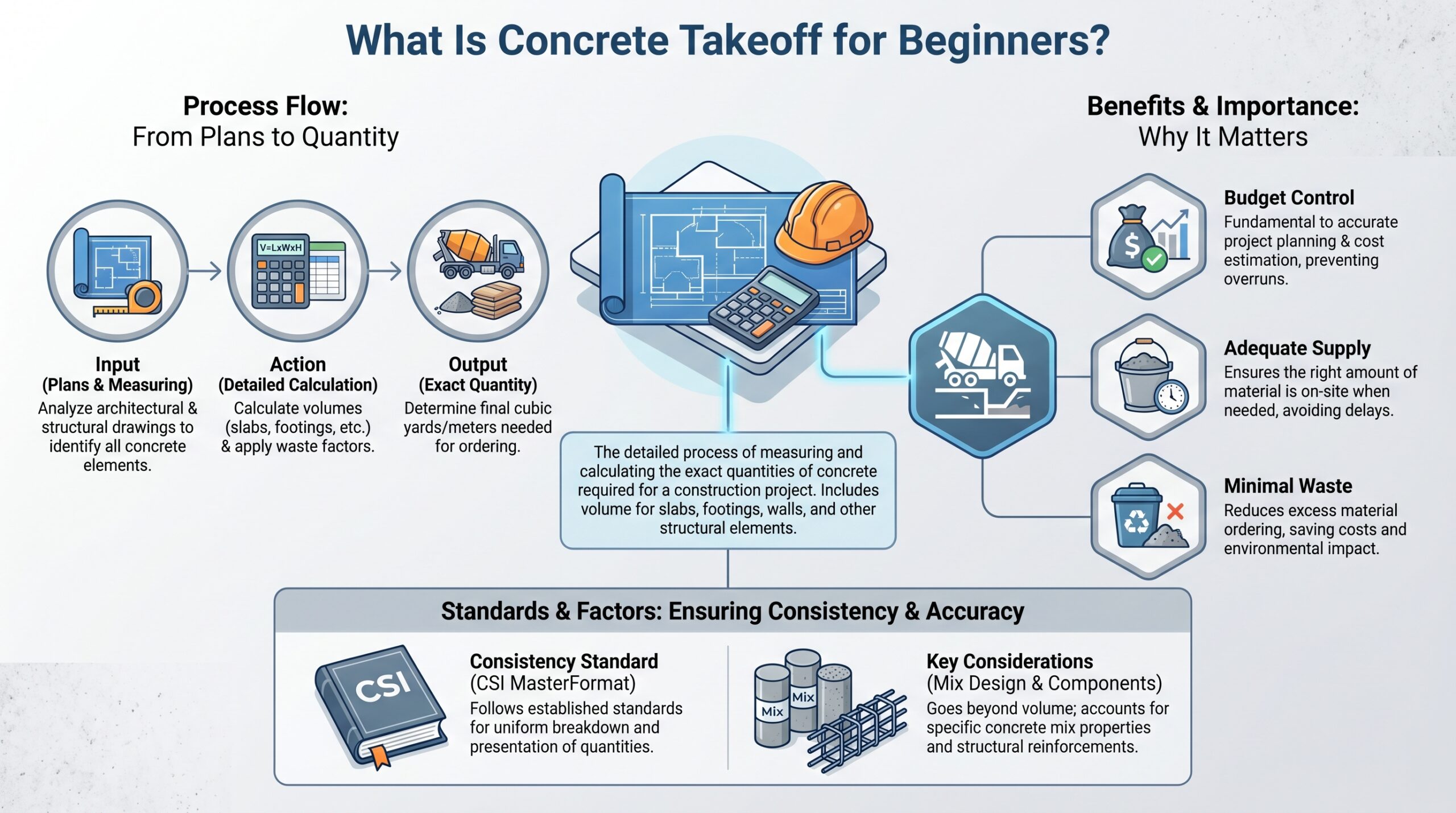
A concrete takeoff is the detailed process of measuring and calculating the exact quantities of concrete required for a construction project. This includes volume for slabs, footings, walls, and other structural elements. It’s a critical step in material estimation, ensuring adequate supply without excessive waste.
Accurate concrete quantity calculations are fundamental to project planning and budget control. Following standards like CSI MasterFormat ensures consistency in how these quantities are broken down and presented. This process involves not just volume but also considers factors like concrete mix design and structural components.
Why Accurate Concrete Quantity Calculation Matters for Your Project
In the construction industry, material costs can represent a significant portion of a project’s budget. For concrete, this can easily reach 10-15% of total direct costs on many projects. Miscalculations here can lead to substantial financial losses and operational headaches. By 2025, projects relying on precise digital takeoffs will have a distinct competitive edge.
- Cost Control: Prevents overspending on excess material or incurring rush delivery fees for shortages.
- Time Efficiency: Avoids project delays caused by waiting for additional concrete deliveries or re-ordering.
- Risk Mitigation: Reduces the risk of structural compromises due to insufficient material or rework due to mistakes.
- Bid Success: Delivers competitive, data-backed bids that instill confidence in clients.
- Client Relationships: Fosters trust through transparent and predictable project costs.
Struggling with estimate accuracy? Our construction estimating service at https://phoenixestimations.com/construction-estimating-service delivers bid-ready numbers fast.
How to Calculate Concrete Volume Step-by-Step
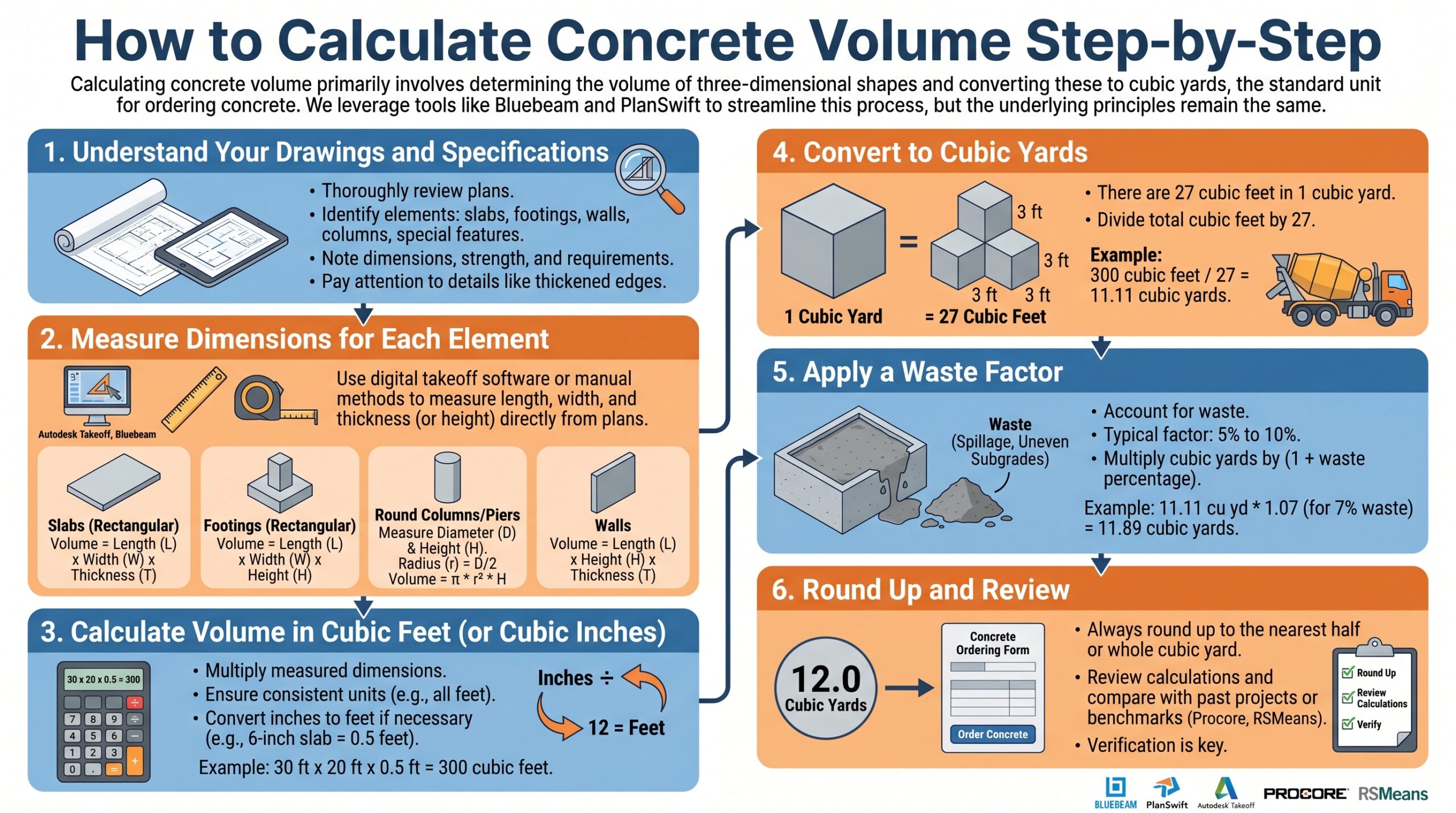
Calculating concrete volume primarily involves determining the volume of three-dimensional shapes. The goal is to convert these volumes into cubic yards, the standard unit for ordering concrete in North America. We leverage advanced tools like Bluebeam and PlanSwift to streamline this process, but the underlying principles remain the same.
-
Step 1: Understand Your Drawings and Specifications
Thoroughly review architectural and structural plans. Identify all concrete elements: slabs, footings, walls, columns, and special features. Note dimensions, concrete strength, and any specific requirements. Pay close attention to details like thickened edges or depressions.
-
Step 2: Measure Dimensions for Each Element
Use a digital takeoff software like Autodesk Takeoff or Bluebeam to accurately measure the length, width, and thickness (or height) of each concrete component directly from the plans. For manual methods, a scale ruler is essential.
- For Slabs (Rectangular): Measure Length (L), Width (W), and Thickness (T). The volume is L x W x T.
- For Footings (Rectangular): Measure Length (L), Width (W), and Height (H). The volume is L x W x H.
- For Round Columns/Piers: Measure Diameter (D) and Height (H). Calculate radius (r = D/2). Volume is π * r² * H.
- For Walls: Measure Length (L), Height (H), and Thickness (T). Volume is L x H x T.
-
Step 3: Calculate Volume in Cubic Feet (or Cubic Inches)
Multiply the measured dimensions. Ensure all units are consistent (e.g., all feet or all inches). If using inches, convert to feet by dividing by 12 before multiplying. For example, a 6-inch slab is 0.5 feet.
-
Step 4: Convert to Cubic Yards
Concrete is typically ordered in cubic yards. There are 27 cubic feet in 1 cubic yard (3 ft x 3 ft x 3 ft = 27 cu ft).
- Divide your total cubic feet by 27 to get cubic yards.
- Example: A slab 30 ft long x 20 ft wide x 0.5 ft thick = 300 cubic feet. 300 cu ft / 27 cu ft/cu yd = 11.11 cubic yards.
-
Step 5: Apply a Waste Factor
Always account for waste due to spillage, over-excavation, uneven subgrades, or measurement discrepancies. A typical concrete waste factor ranges from 5% to 10%, depending on site conditions and complexity.
- Multiply your calculated cubic yards by (1 + waste factor percentage). For example, 11.11 cu yd * 1.07 (for 7% waste) = 11.89 cubic yards.
-
Step 6: Round Up and Review
Always round up to the nearest half or whole cubic yard when ordering. Review all calculations and compare against similar past projects or industry benchmarks. Procore and RSMeans data can be invaluable for verification.
Tools and Methods for Concrete Takeoff
The evolution of construction technology has transformed how we approach concrete quantity calculation. While manual methods offer foundational understanding, digital tools provide unparalleled speed and accuracy.
| Factor | Manual Method | Digital/Software Method |
|---|---|---|
| Speed | Slow, especially for complex projects. | Fast, instant calculations from digital plans. |
| Accuracy | Prone to human error, scaling mistakes. | Highly accurate, minimizes measurement errors. |
| Cost | Low initial tool cost (ruler, calculator). | Higher initial software investment. |
| Scalability | Labor-intensive for large or multiple projects. | Easily scales for projects of any size and complexity. |
| Audit Trail | Limited, relies on handwritten notes. | Comprehensive, traceable measurements and reports. |
At Phoenix Estimations, we utilize industry-leading software such as Bluebeam, PlanSwift, Procore, RSMeans, and Autodesk Takeoff. These tools enable us to perform precise slab takeoff, footing concrete calculation, and overall concrete estimating with unmatched efficiency and reliability.
Real-World Example — How Phoenix Estimations Solved It
For the Lincoln University exterior finishes project, our team faced the challenge of ensuring precise material takeoffs for various components, including concrete elements for cladding and foundations, to keep the project within a tight budget without compromising design integrity. The initial estimates from the client’s internal team had discrepancies.
Our action was to conduct a detailed concrete takeoff using Bluebeam and PlanSwift, meticulously measuring every concrete slab, footing, and wall section. We applied specific waste factors appropriate for the site conditions and verified all calculations against RSMeans cost data. This precise approach identified opportunities for value engineering and reduced material waste significantly. The measurable outcome was a revised, data-backed estimate that secured client approval immediately, eliminating potential budget overruns and ensuring the project remained on track. This proactive estimation saved the client significant costs and prevented delays, demonstrating the power of accurate quantity calculation.
Common Concrete Takeoff Mistakes to Avoid
Even experienced professionals can make missteps in concrete estimating. Awareness of these common errors is key to improving accuracy and avoiding costly rework or delays.
- Ignoring Waste Factors: Underestimating or omitting a concrete waste factor leads to material shortages and often expensive rush orders. Always factor in 5-10% for typical projects, more for complex pours.
- Incorrect Unit Conversions: Mixing feet, inches, and metric units without proper conversion is a frequent culprit for major errors. Ensure all dimensions are in consistent units before calculating volume, then convert to cubic yards accurately.
- Overlooking Structural Details: Failing to account for thickened edges, rebar clearances, depressions, or irregular shapes can result in inaccurate concrete quantity calculations. Detailed review of structural drawings is essential.
- Inadequate Subgrade Preparation: Uneven or poorly compacted subgrades can cause concrete to spread more than anticipated, leading to underestimation. A site visit or clear communication with the site team is vital.
- Not Verifying Drawings: Working with outdated or incomplete drawings is a recipe for disaster. Always confirm that you are using the latest revisions and clarify any ambiguities with the architect or engineer.
- Rounding Down Too Early: Prematurely rounding down during intermediate calculations can accumulate errors, leading to an overall underestimation of concrete. Always round up at the final ordering stage.
Benefits of Professional Concrete Estimating Services
While understanding concrete takeoff for beginners is valuable, the complexity of modern construction projects often demands specialized expertise. Professional concrete estimating services offer a significant advantage, translating directly into improved business outcomes.
- Higher ROI: Accurate estimates minimize material waste and labor overruns, boosting project profitability.
- Reduced Risk: Experts identify potential issues early, mitigating financial and scheduling risks.
- Significant Time Savings: Outsourcing takeoffs frees up your internal team to focus on core project management and execution.
- Increased Bid Win Rates: Data-backed, precise bids are more competitive and inspire greater client confidence.
- Trade-Specific Accuracy: Our team provides detailed, trade-specific accuracy for all concrete elements, from foundations to decorative finishes.
- Compliance & Standards: We ensure all calculations adhere to industry standards like AACE International and ICC building codes.
At Phoenix Estimations, our seasoned estimators leverage advanced software and deep industry knowledge to provide flawless concrete takeoffs, giving you the edge you need for successful project delivery.
FAQ About Concrete Takeoff and Calculation
Q1: What is the typical concrete waste factor I should apply?
A1: The typical concrete waste factor ranges from 5% to 10%, depending on the project’s complexity, site conditions, and the type of concrete pour. For rough or uneven surfaces, a higher percentage might be necessary to ensure sufficient material. Always round up when placing your final order.
Q2: How do I calculate concrete volume for a footing?
A2: To calculate concrete volume for a footing, measure its length, width, and height. Multiply these three dimensions (L x W x H) to get the volume in cubic feet. Then, divide the cubic feet by 27 to convert it to cubic yards for ordering. Don’t forget to add a waste factor.
Q3: Why is it important to use cubic yards for concrete ordering?
A3: Concrete is universally sold and delivered in cubic yards in the United States and Canada. Understanding how to perform cubic yard concrete calculation is crucial for accurate ordering, preventing shortages or costly overages, and ensuring clear communication with concrete suppliers.
Q4: Can I use software for concrete quantity calculation as a beginner?
A4: Yes, software like Bluebeam, PlanSwift, or Autodesk Takeoff can greatly assist beginners. These tools automate measurements and calculations, reducing manual errors. While the principles of concrete takeoff for beginners remain, software enhances efficiency and accuracy significantly. Phoenix Estimations utilizes these tools for all our clients.
Q5: What are the main components to consider for a comprehensive concrete estimating project?
A5: A comprehensive concrete estimating project includes calculating the volume for all concrete elements (slabs, footings, walls, columns), accounting for waste factors, considering formwork and rebar quantities, and factoring in labor, equipment, and delivery costs. It’s about a holistic view of all related expenses.
Key Takeaways
- Most Important Insight: Accurate concrete takeoff is the foundation for cost control and successful project execution.
- Actionable Step: Systematically measure dimensions, calculate volume in cubic yards, and apply an appropriate waste factor.
- Business Risk If Ignored: Significant budget overruns, project delays, and compromised structural integrity.
- How Phoenix Estimations Addresses This Need: We provide precise, data-backed concrete quantity calculations using advanced software, ensuring your projects stay on budget and on schedule.
Don’t let inaccurate concrete estimates erode your project’s profitability. At Phoenix Estimations, we have delivered accurate trade-specific estimates and detailed takeoffs for 2,000+ projects across residential, commercial, and industrial sectors in the US and Canada — with turnaround times that match your bid schedule. Request a Construction Estimate: https://phoenixestimations.com/construction-estimating-service | Get a Professional Quantity Takeoff: https://phoenixestimations.com/quantity-takeoff-services | Contact us: https://phoenixestimations.com/contactUs.php
Conclusion
Mastering concrete takeoff for beginners is an essential skill that directly impacts your project’s financial health and timeline. From understanding basic volume formulas to applying a realistic concrete waste factor, precision is paramount. While the initial learning curve can be steep, the benefits of accurate concrete quantity calculation — reduced waste, fewer delays, and better bid outcomes — are undeniable. At Phoenix Estimations, we stand as your partner in achieving this precision. Our team leverages years of experience and advanced software to deliver exact, bid-ready concrete takeoffs, empowering you to build with confidence across the US and Canada. Let us help you lay a solid foundation for your next project’s success.