
Introduction
In commercial construction, electrical work accounts for a significant portion of the total project budget, often ranging from 10% to 15%. Overlooking critical details in this phase can lead to substantial cost overruns and project delays. Understanding how to estimate electrical wiring costs for a commercial building precisely is not just beneficial; it’s essential for profitability and project success.
At Phoenix Estimations, with over 2,000 completed projects and 4,000+ satisfied clients across the US and Canada, we have seen firsthand what accurate estimating does for project outcomes. Our team knows the intricacies of commercial electrical systems. This guide will walk you through the process, tools, and best practices to achieve precise electrical cost estimates, ensuring your bids are competitive and profitable.
TL;DR Summary
Accurate electrical wiring cost estimation is critical for commercial projects, impacting budget, schedule, and bid success. This guide outlines a step-by-step process covering material takeoffs, labor calculations, and overhead, leveraging advanced software like Bluebeam and RSMeans. By avoiding common mistakes and utilizing professional services, contractors can secure precise, bid-ready estimates, ensuring project profitability and compliance. Phoenix Estimations offers expert electrical estimating services for all commercial needs.
Table of Contents
- What Is Electrical Wiring Cost Estimation?
- Why Accurate Electrical Wiring Estimation Matters for Your Project
- How to Estimate Electrical Wiring Costs for Commercial Buildings Step-by-Step
- Tools and Methods for Electrical Wiring Cost Estimation
- Real-World Example — How Phoenix Estimations Solved It
- Common Electrical Wiring Cost Estimating Mistakes to Avoid
- Benefits of Professional Electrical Estimating Services
- FAQ Section
- Key Takeaways
- Conclusion
What Is Electrical Wiring Cost Estimation?
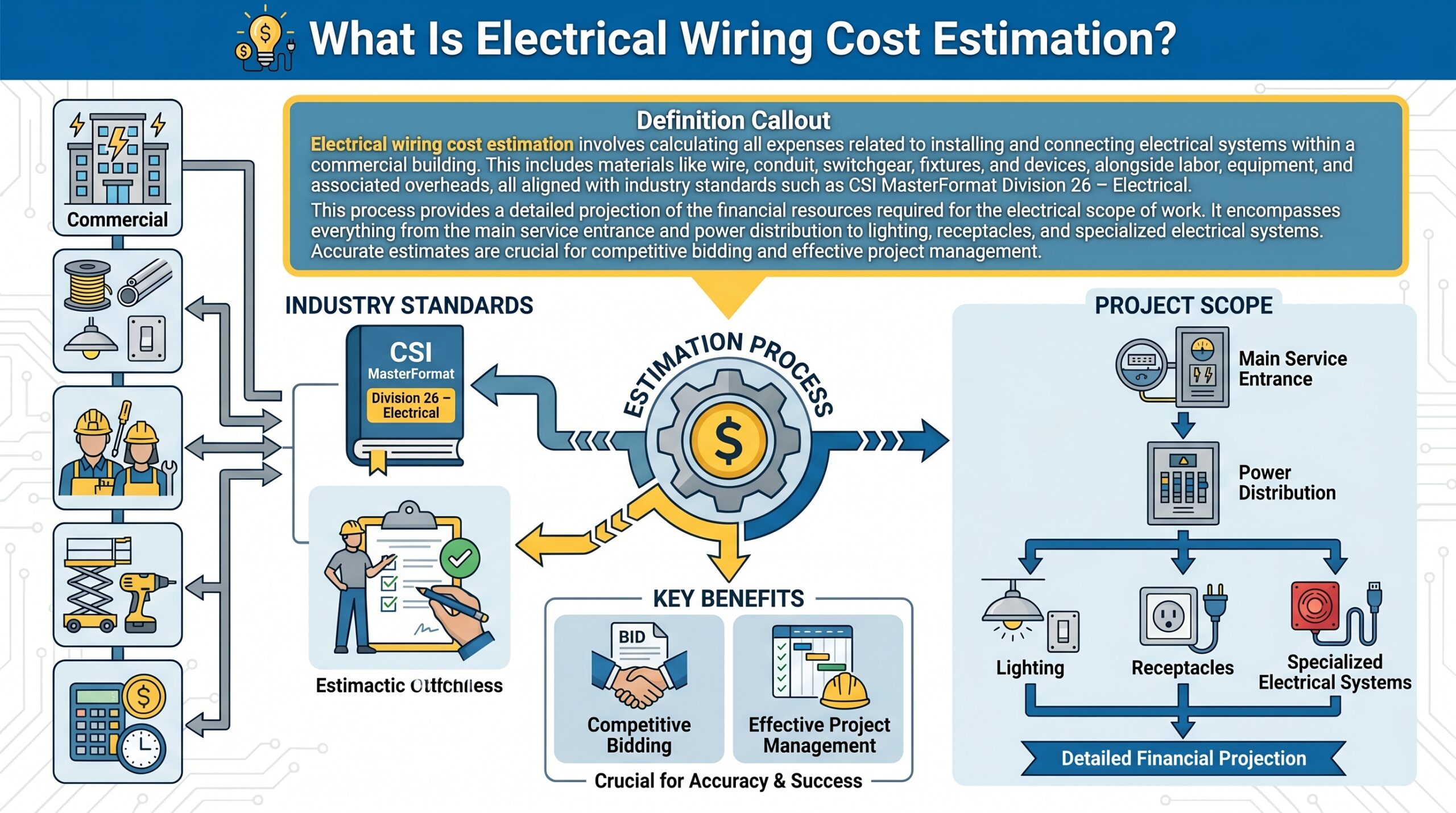
This process provides a detailed projection of the financial resources required for the electrical scope of work. It encompasses everything from the main service entrance and power distribution to lighting, receptacles, and specialized electrical systems. Accurate estimates are crucial for competitive bidding and effective project management.
Why Accurate Electrical Wiring Estimation Matters for Your Project
Precise electrical cost estimation is foundational to any successful commercial construction project. Studies show that inaccurate estimates can lead to project cost overruns averaging 10-15%, directly impacting profitability. By 2026, the demand for transparent and accurate cost projections will only intensify, driven by tighter budgets and increased competition.
- Cost Control: Prevents budget overruns and ensures financial viability.
- Time Savings: Reduces delays caused by unexpected material or labor costs.
- Risk Mitigation: Identifies potential issues early, minimizing change orders and disputes.
- Bid Success: Enables competitive yet profitable bidding, improving win rates.
- Client Relationships: Builds trust through transparent and predictable project costs.
Accurate estimation extends beyond simple numbers; it impacts overall project budgeting and the success of related trades, including MEP estimating services. A detailed electrical takeoff ensures all components, from conduit estimating to service and distribution cost, are accounted for.
Struggling with estimate accuracy? Our construction estimating service at https://phoenixestimations.com/construction-estimating-service delivers bid-ready numbers fast.
How to Estimate Electrical Wiring Costs for Commercial Buildings Step-by-Step
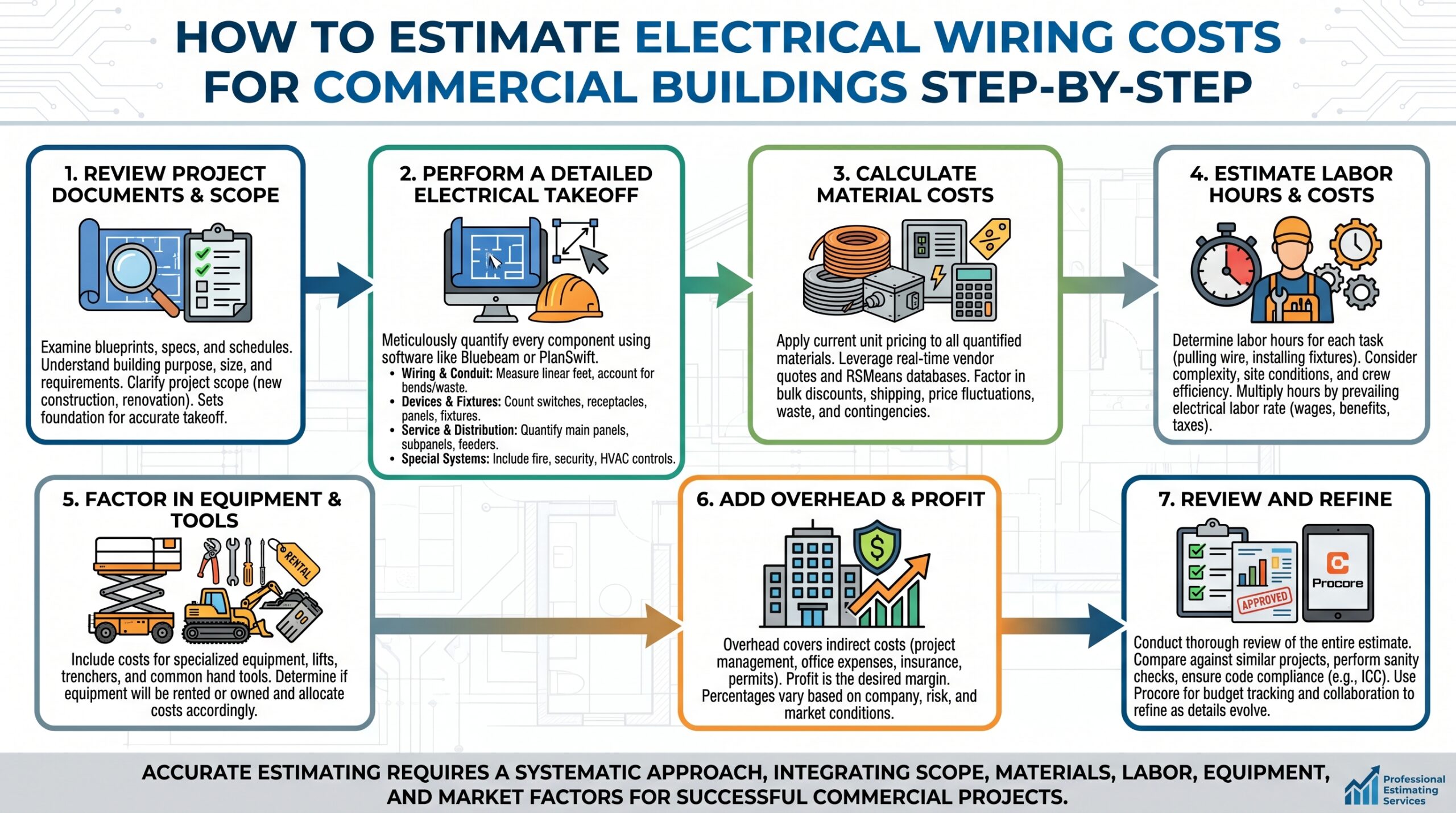
Estimating commercial electrical wiring costs requires a systematic approach. Here’s how our team tackles it:
-
Review Project Documents and Scope
Thoroughly examine blueprints, specifications, and schedules. Understand the building’s purpose, size, and specific electrical requirements. Clarify the project scope: new construction, renovation, or specific system upgrades. This initial review sets the foundation for accurate construction takeoff services.
-
Perform a Detailed Electrical Takeoff
This is where the bulk of material quantification happens. Utilizing software like Bluebeam or PlanSwift, we meticulously count every component.
- Wiring & Conduit: Measure linear feet of all wire types (copper, aluminum) and conduit (EMT, rigid, flexible), accounting for bends, junctions, and waste. This is crucial for electrical estimating services.
- Devices & Fixtures: Count every switch, receptacle, data port, junction box, panel, breaker, and light fixture. For lighting estimate commercial projects, consider fixture type, mounting, and controls.
- Service & Distribution: Quantify main service panels, subpanels, transformers, and associated feeders. The service and distribution cost is a significant line item.
- Special Systems: Include fire alarm, security, communication, and HVAC control wiring if part of the electrical scope.
-
Calculate Material Costs
Apply current unit pricing to all quantified materials. We leverage real-time vendor quotes and industry cost databases like RSMeans. Factor in bulk discounts, shipping, and potential price fluctuations. Always account for waste and contingencies.
-
Estimate Labor Hours and Costs
This is often the most variable component. Determine the number of labor hours required for each task (e.g., pulling wire, installing fixtures, connecting panels). Consider project complexity, site conditions, and crew efficiency. Multiply hours by the prevailing electrical labour rate, including wages, benefits, and payroll taxes.
-
Factor in Equipment and Tools
Include costs for specialized electrical equipment, lifts, trenchers, and common hand tools. Determine whether equipment will be rented or owned, and allocate costs accordingly.
-
Add Overhead and Profit
Overhead covers indirect costs like project management, office expenses, insurance, and permits. Profit is the desired margin for the contractor. These percentages vary widely based on company structure, project risk, and market conditions.
-
Review and Refine
Conduct a thorough review of the entire estimate. Compare it against similar projects, perform sanity checks, and ensure compliance with all relevant codes (e.g., ICC building codes). Use Procore for budget tracking and collaboration to refine the estimate as project details evolve.
Tools and Methods for Electrical Wiring Cost Estimation
The right tools significantly enhance accuracy and efficiency in electrical estimating. While manual methods still exist, digital solutions offer unparalleled advantages.
| Factor | Manual Method | Digital/Software Method |
|---|---|---|
| Speed | Slow, laborious, prone to delays | Fast, automated takeoffs, rapid adjustments |
| Accuracy | High risk of human error, omissions | High precision, fewer errors, consistent data |
| Cost | Lower initial software cost, higher labor cost over time | Higher initial software investment, significant long-term savings |
| Scalability | Limited by estimator’s time, difficult for large projects | Easily scalable for projects of any size and complexity |
| Audit Trail | Difficult to track changes, limited transparency | Comprehensive audit trails, transparent revisions, easy collaboration |
At Phoenix Estimations, we leverage industry-leading software:
- Bluebeam: For precise digital takeoffs from PDFs and plan sets, essential for quantity takeoff in construction.
- PlanSwift: Offers advanced takeoff capabilities, especially useful for complex electrical layouts.
- Procore: Integrates estimating data with project management, enhancing collaboration and cost control.
- RSMeans: Provides up-to-date, localized cost data for materials and labor, ensuring our cost estimating service is highly accurate.
- Autodesk Takeoff: For 3D model-based takeoffs, offering a holistic view of electrical components.
Real-World Example — How Phoenix Estimations Solved It
A prime example of our precision in electrical estimating is the Levi’s Store renovation in Ottawa. The client faced an unexpected electrical fault during a critical phase, requiring immediate repair and a fast, accurate cost estimate to avoid project stalls.
Challenge: An electrical fault was identified, necessitating a rapid assessment of repair costs, material procurement, and labor. The client needed a precise, bid-ready estimate within hours to secure approval and coordinate timely repairs without impacting the overall renovation schedule.
Action: Our team at Phoenix Estimations moved quickly. We received the updated schematics and within a few hours, performed a targeted electrical takeoff using Bluebeam and PlanSwift. We identified the exact wiring, conduit, and device replacements needed. Leveraging our RSMeans cost data and local labor rates, we generated a comprehensive, data-backed estimate.
Outcome: The accurate cost estimate was delivered within the client’s tight deadline. This rapid response allowed for immediate client approval and the timely coordination of repairs through our network of trusted contractors. The project stayed on schedule and within budget, demonstrating the critical value of fast, accurate electrical estimating services.
Common Electrical Wiring Cost Estimating Mistakes to Avoid
Even experienced estimators can fall victim to common pitfalls. Avoiding these ensures a more accurate and reliable bid.
- Inaccurate Takeoffs: Under-quantifying materials (wire, conduit) or missing small components adds up quickly. This often stems from rushing or not using proper takeoff software.
- Neglecting Code Compliance: Electrical codes (like the NEC in the US or CEC in Canada) dictate specific wiring methods, conduit fill, and device placement. Ignoring these leads to rework and costly penalties.
- Underestimating Labor Hours: Failing to account for complex installations, difficult access, site conditions, or the learning curve for new technologies can drastically inflate electrical labour rate costs.
- Overlooking “Soft” Costs: Permits, inspections, engineering fees, project management, and temporary power are often forgotten, yet are significant contributors to the overall commercial electrical cost per square foot.
- Ignoring Price Volatility: Material prices, especially for copper wire, can fluctuate rapidly. Not building in a contingency or using outdated pricing data can quickly erode profit margins.
- Insufficient Contingency: Unexpected site conditions, design changes, or unforeseen issues are common. A reasonable contingency (typically 5-10%) is vital to absorb these shocks without impacting profitability.
Benefits of Professional Electrical Estimating Services
Engaging professional electrical estimating services offers distinct business advantages:
- Higher ROI: Accurate estimates prevent costly errors and rework, leading to greater project profitability.
- Reduced Risk: Expert analysis identifies potential pitfalls early, minimizing financial exposure and project delays.
- Time Savings: Outsourcing estimation frees up your internal team to focus on core project management and execution.
- Increased Bid Win Rates: Professionally prepared, competitive bids stand out, securing more projects for your firm.
- Access to Expertise: Benefit from specialized knowledge in complex electrical systems, advanced software, and up-to-date cost data.
- Compliance Assurance: Ensure estimates adhere to all relevant industry standards and building codes.
At Phoenix Estimations, our team provides trade-specific accuracy, delivering detailed electrical takeoffs and comprehensive cost estimates. We ensure you have the precise numbers needed to bid confidently and manage your commercial electrical projects effectively.
FAQ Section
Q1: What is the average commercial electrical cost per square foot for wiring?
A1: Commercial electrical wiring costs per square foot vary widely, typically ranging from $8 to $25, depending on building type, complexity, and location. This includes materials, labor for installation, and basic fixtures. Factors like specialized equipment, advanced lighting controls, or unique power distribution needs can significantly increase this figure.
Q2: How do you calculate electrical labor costs for a commercial project?
A2: Electrical labor costs are calculated by estimating the total man-hours required for all tasks (e.g., pulling wire, installing devices, testing) and multiplying by the fully loaded hourly electrical labour rate. This rate includes wages, benefits, taxes, insurance, and overhead. Experience, project complexity, and crew size all influence the total labor hours.
Q3: What factors significantly affect electrical wiring costs in commercial construction?
A3: Key factors include the building’s size and function, system complexity (e.g., smart building technology), material types (copper vs. aluminum), labor availability and rates, local building codes, accessibility of installation areas, and project timeline. Market demand for materials and labor also plays a crucial role in overall cost.
Q4: What software is commonly used for accurate commercial electrical estimating?
A4: Industry-standard software for accurate commercial electrical estimating includes Bluebeam and PlanSwift for precise takeoffs, RSMeans for up-to-date cost data, and Procore for integrated project management and budget tracking. These tools enhance efficiency, reduce errors, and provide a comprehensive overview of project costs.
Q5: How can Phoenix Estimations ensure accuracy in my commercial electrical estimate?
A5: At Phoenix Estimations, we ensure accuracy through a combination of experienced estimators, advanced software like Bluebeam and RSMeans, and adherence to industry standards. We perform detailed, trade-specific takeoffs and continuously update our cost data. Our meticulous review process minimizes errors, providing you with reliable, bid-ready electrical estimating services.
Key Takeaways
- Accurate electrical wiring cost estimation is paramount for commercial project profitability and avoiding costly overruns.
- A systematic approach, including detailed takeoffs and precise labor calculations, is essential for a reliable estimate.
- Ignoring common pitfalls like inaccurate takeoffs or underestimating labor can severely impact your project’s financial health.
- Phoenix Estimations provides expert, trade-specific electrical estimating services, ensuring your bids are competitive and backed by precise data.
Ready for an Accurate Electrical Estimate?
Don’t let inaccurate electrical estimates compromise your commercial project’s profitability or timeline. At Phoenix Estimations, we have delivered accurate trade-specific estimates and detailed takeoffs for 2,000+ projects across residential, commercial, and industrial sectors in the US and Canada — with turnaround times that match your bid schedule. Our expertise ensures your bids are competitive and your projects stay on budget.
Request a Construction Estimate
Get a Professional Quantity Takeoff
Or Contact us today to discuss your project needs.
Conclusion
Mastering how to estimate electrical wiring costs for a commercial building is a critical skill for any contractor or developer aiming for consistent project success and profitability. It demands meticulous attention to detail, a deep understanding of electrical systems, and the right tools. From precise material takeoffs to accurate labor calculations and adherence to industry standards, every step contributes to a robust and reliable estimate.
In a competitive market, an accurate estimate is more than just a number; it’s a strategic advantage. It allows for competitive bidding, effective project management, and strong client relationships. By following the comprehensive steps outlined, or by partnering with experienced professionals, you can ensure your commercial electrical projects are built on a foundation of financial certainty. Don’t leave your project’s financial health to chance; invest in accurate electrical estimating.