
In complex construction projects, MEP systems often account for 30-50% of the total budget. Underestimating these critical components can derail an entire project, leading to costly delays and disputes. Understanding what is included in MEP estimating is not just good practice; it’s essential for project viability and profitability.
At Phoenix Estimations, with over 2,000 completed projects and 4,000+ satisfied clients across the US and Canada, we have seen firsthand what accurate estimating does for project outcomes. Our team knows that precise mechanical, electrical, and plumbing cost projections are non-negotiable.
This comprehensive guide will break down every aspect of MEP estimating. You will learn its core components, why it’s critical, and how professional services can secure your project’s financial success.
TL;DR Summary
- Core Insight: MEP estimating encompasses all mechanical, electrical, and plumbing costs, forming a significant portion of total project expenditure.
- Key Process: It involves detailed takeoffs for materials, labor, equipment, and overhead across all three disciplines, often leveraging advanced software.
- Primary Benefit: Accurate MEP estimates prevent budget overruns, enhance bid competitiveness, and ensure smoother project execution.
- Action Step: Phoenix Estimations provides expert, trade-specific MEP estimating services to deliver bid-ready numbers fast.
What Is Included in MEP Estimating?
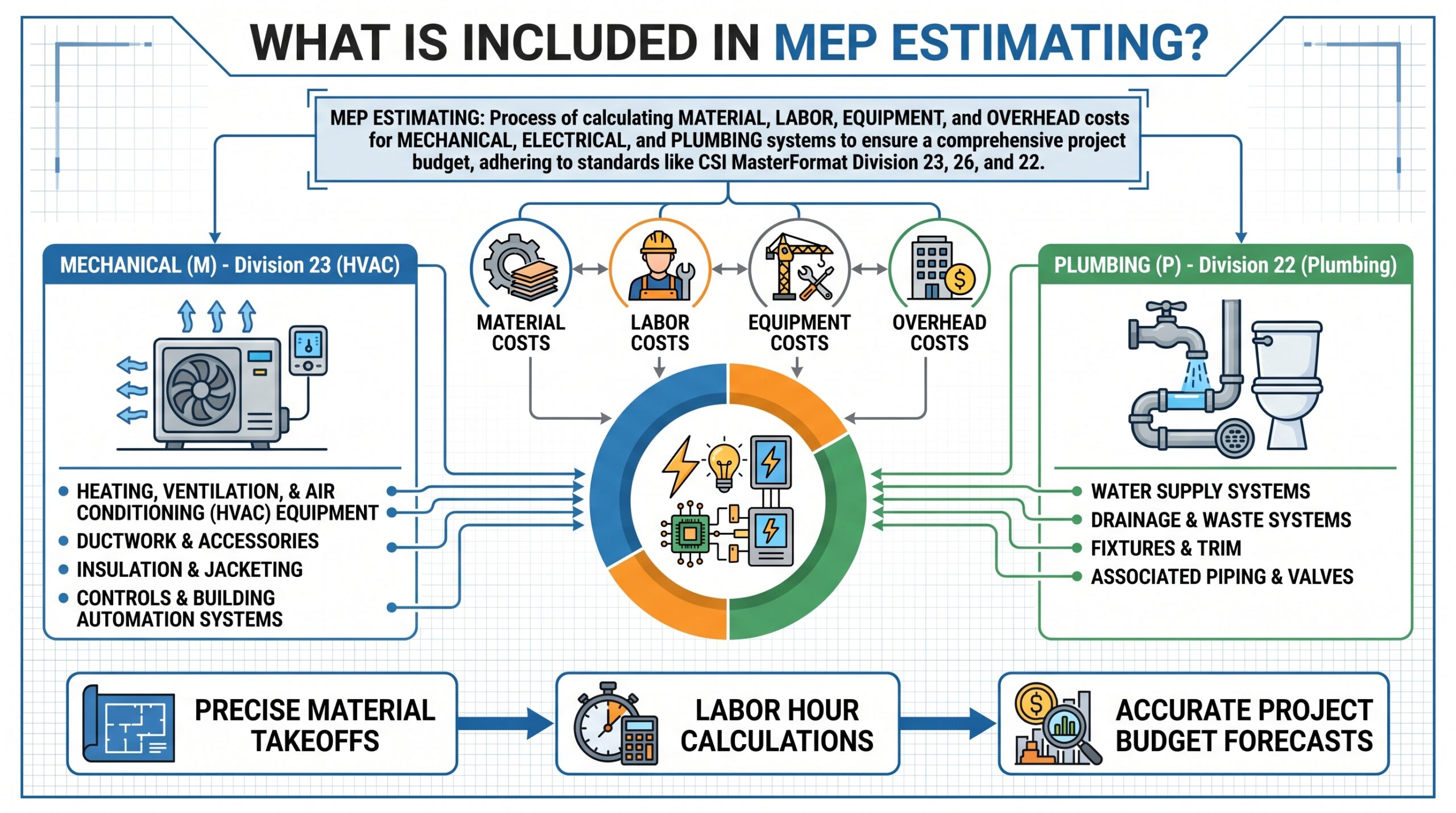
MEP estimating is the process of calculating the material, labor, equipment, and overhead costs associated with a building’s mechanical, electrical, and plumbing systems. It covers everything from HVAC to lighting and piping, ensuring a comprehensive project budget. This detailed cost analysis is crucial for all building systems, adhering to industry standards like CSI MasterFormat Division 23 (HVAC), 26 (Electrical), and 22 (Plumbing).
Understanding what is included in MEP estimating requires a breakdown of each discipline. Mechanical systems encompass heating, ventilation, and air conditioning (HVAC) equipment, ductwork, insulation, and controls. Electrical systems involve power distribution, lighting, fire alarms, data cabling, and specialized equipment wiring. Plumbing covers water supply, drainage, waste systems, fixtures, and associated piping. Each component demands precise material takeoffs and labor hour calculations for accurate project budget forecasts.
Why Comprehensive MEP Estimating Matters for Your Project
In 2023, inaccurate MEP estimates contributed to over 15% of project budget overruns in commercial construction. The complexity and interconnectedness of MEP systems make precise cost estimation paramount. A thorough MEP cost estimation provides a clear financial roadmap, preventing surprises and securing project profitability.
- Cost Control: Accurate numbers allow for tight budget management, identifying potential savings through value engineering.
- Time Savings: Detailed estimates minimize change orders and rework, keeping projects on schedule.
- Risk Mitigation: Identifying potential issues early reduces financial and operational risks.
- Bid Competitiveness: Precise bids, reflecting true costs, increase your chances of winning projects.
- Client Relationships: Transparent and reliable estimates build trust and client satisfaction.
As we look towards 2025 and beyond, integrating energy-efficient and smart building technologies into MEP systems will only increase their complexity. Comprehensive MEP estimating is vital for navigating these advancements successfully. It ensures your project remains compliant, cost-effective, and future-proof.
Struggling with estimate accuracy? Our construction estimating service at https://phoenixestimations.com/construction-estimating-service delivers bid-ready numbers fast.
How to Approach MEP Estimating Step-by-Step
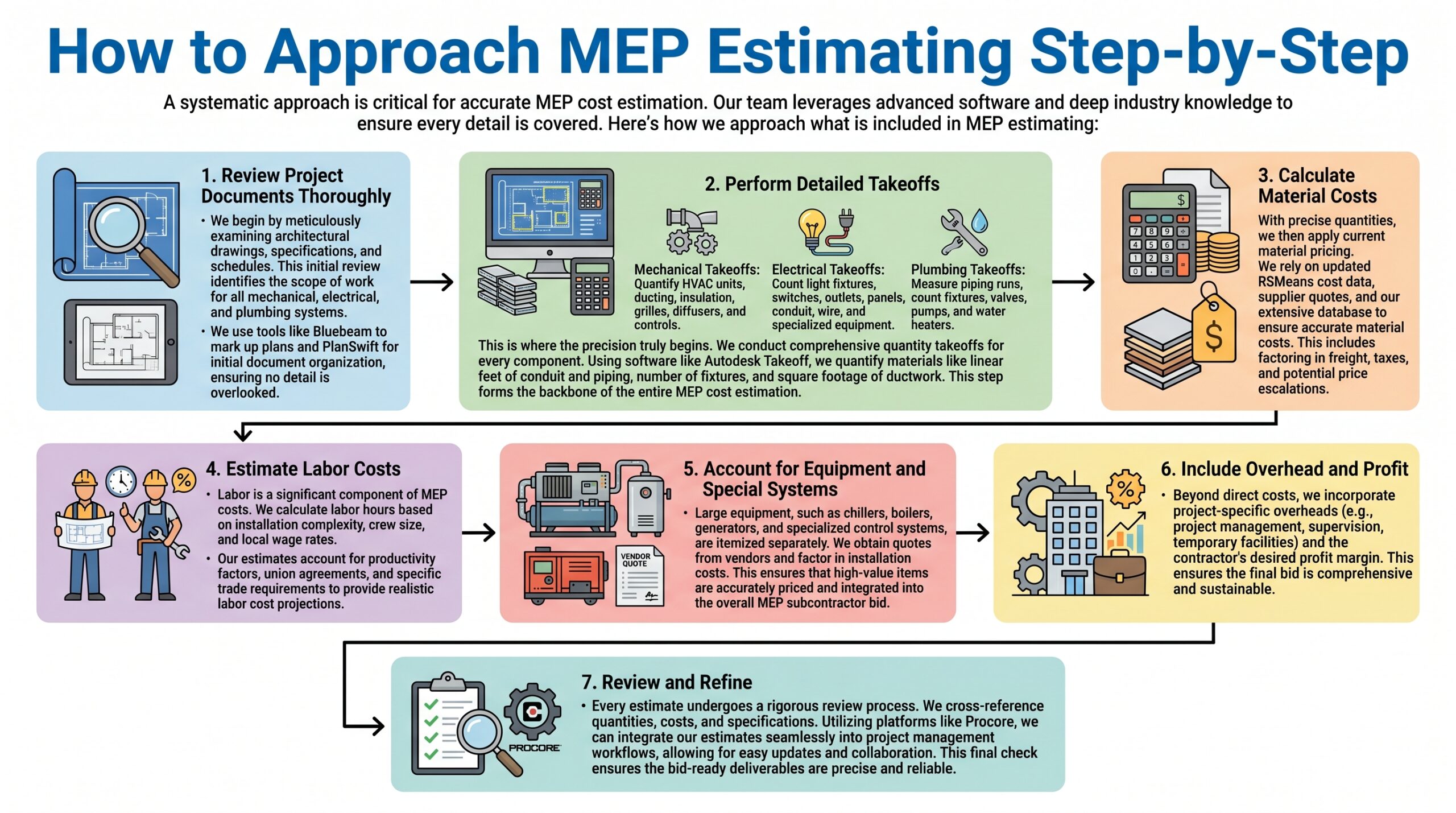
A systematic approach is critical for accurate MEP cost estimation. Our team leverages advanced software and deep industry knowledge to ensure every detail is covered. Here’s how we approach what is included in MEP estimating:
-
1. Review Project Documents Thoroughly
We begin by meticulously examining architectural drawings, specifications, and schedules. This initial review identifies the scope of work for all mechanical, electrical, and plumbing systems. We use tools like Bluebeam to mark up plans and PlanSwift for initial document organization, ensuring no detail is overlooked.
-
2. Perform Detailed Takeoffs
This is where the precision truly begins. We conduct comprehensive quantity takeoffs for every component. Using software like Autodesk Takeoff, we quantify materials like linear feet of conduit and piping, number of fixtures, and square footage of ductwork. This step forms the backbone of the entire MEP cost estimation.
- Mechanical Takeoffs: Quantify HVAC units, ducting, insulation, grilles, diffusers, and controls.
- Electrical Takeoffs: Count light fixtures, switches, outlets, panels, conduit, wire, and specialized equipment.
- Plumbing Takeoffs: Measure piping runs, count fixtures, valves, pumps, and water heaters.
-
3. Calculate Material Costs
With precise quantities, we then apply current material pricing. We rely on updated RSMeans cost data, supplier quotes, and our extensive database to ensure accurate material costs. This includes factoring in freight, taxes, and potential price escalations.
-
4. Estimate Labor Costs
Labor is a significant component of MEP costs. We calculate labor hours based on installation complexity, crew size, and local wage rates. Our estimates account for productivity factors, union agreements, and specific trade requirements to provide realistic labor cost projections.
-
5. Account for Equipment and Special Systems
Large equipment, such as chillers, boilers, generators, and specialized control systems, are itemized separately. We obtain quotes from vendors and factor in installation costs. This ensures that high-value items are accurately priced and integrated into the overall MEP subcontractor bid.
-
6. Include Overhead and Profit
Beyond direct costs, we incorporate project-specific overheads (e.g., project management, supervision, temporary facilities) and the contractor’s desired profit margin. This ensures the final bid is comprehensive and sustainable.
-
7. Review and Refine
Every estimate undergoes a rigorous review process. We cross-reference quantities, costs, and specifications. Utilizing platforms like Procore, we can integrate our estimates seamlessly into project management workflows, allowing for easy updates and collaboration. This final check ensures the bid-ready deliverables are precise and reliable.
Essential Tools and Methods for Accurate MEP Estimating
The landscape of construction estimating has evolved dramatically. Manual methods are increasingly replaced by powerful software solutions that enhance speed, accuracy, and collaboration. When considering what is included in MEP estimating, the tools used are just as critical as the process itself.
Key Software Utilized:
- Bluebeam: For digital plan markup, annotations, and initial quantity takeoffs directly from PDFs.
- PlanSwift: Industry-leading takeoff software for quick and accurate measurement of lengths, areas, and counts for all MEP components.
- Procore: For project management integration, allowing estimates to flow seamlessly into budgeting, scheduling, and procurement.
- RSMeans: An invaluable resource for up-to-date cost data on materials, labor, and equipment across various regions.
- Autodesk Takeoff: For advanced 3D model-based takeoffs, especially useful for complex MEP systems and clash detection.
Comparison: Manual vs. Digital/Software Methods
| Factor | Manual Method | Digital/Software Method |
|---|---|---|
| Speed | Slow, labor-intensive | Fast, automated calculations |
| Accuracy | Prone to human error, inconsistencies | High, precise measurements, reduced errors |
| Cost | Lower initial software cost, higher labor cost | Higher initial software investment, lower long-term labor cost |
| Scalability | Difficult for large, complex projects | Highly scalable for projects of any size |
| Audit Trail | Limited, hard to track changes | Comprehensive, clear digital audit trail |
At Phoenix Estimations, we combine the best of these advanced tools with our team’s extensive experience. This dual approach ensures both efficiency and the nuanced understanding required for precise MEP cost estimation.
Real-World Example — How Phoenix Estimations Solved It
Understanding what is included in MEP estimating is best illustrated through real-world application. Our team frequently tackles complex challenges, delivering solutions that keep projects on track and within budget.
Case Study: Urban Plates Electrical Load Imbalance
Project Type: Commercial Restaurant (Urban Plates)
Challenge: An existing Urban Plates location was experiencing frequent electrical trips due to an unforeseen load imbalance from new kitchen equipment. The client needed a rapid, accurate estimate for a recalibrated power distribution plan to avoid operational downtime and further budget overruns.
Action by Phoenix Estimations: Our electrical estimating team immediately reviewed the existing electrical schematics and the new equipment specifications. We performed a detailed takeoff of required new panels, wiring, breakers, and labor for installation and system recalibration. We leveraged our extensive cost data and vendor network to secure up-to-date pricing for specialized electrical components.
Measurable Outcome: Phoenix Estimations delivered a precise, data-backed estimate within hours. This allowed the client to approve the revised electrical plan and budget immediately. The project was kept on budget and the necessary electrical upgrades were coordinated swiftly, minimizing downtime and ensuring the restaurant’s uninterrupted operation.
Case Study: Levi’s Store Ottawa Electrical Fault
Project Type: Commercial Retail (Levi’s Store)
Challenge: A major electrical fault at a Levi’s Store in Ottawa required immediate repair and an accurate cost estimate to secure approval for the work. The contractor needed a reliable estimate fast to coordinate timely repairs.
Action by Phoenix Estimations: Our specialists quickly assessed the scope of the electrical repair, performing detailed takeoffs for damaged wiring, components, and replacement parts. We calculated labor hours, factoring in emergency response rates and local regulations. Our team provided a comprehensive electrical estimating service, ensuring all aspects of the repair were accounted for.
Measurable Outcome: An accurate cost estimate was delivered within hours. This enabled the contractor to present a clear proposal and secure client approval swiftly. The timely repair was coordinated efficiently through the contractor’s network, preventing prolonged store closure and significant revenue loss.
Common MEP Estimating Mistakes to Avoid
Even seasoned professionals can fall prey to common pitfalls in MEP cost estimation. Being aware of these errors is the first step in avoiding them and ensuring your project’s financial integrity when considering what is included in MEP estimating.
- Underestimating Material Escalation: Material costs, especially for metals and specialized equipment, can fluctuate rapidly. Failing to factor in potential price increases or not securing quotes can lead to significant budget overruns.
- Ignoring Labor Productivity Factors: Labor rates vary by region, and productivity can be affected by site conditions, complexity, and crew experience. Using generic labor rates without accounting for specific project nuances often results in underestimated labor costs.
- Overlooking Code Compliance and Permitting Costs: Local building codes and permitting requirements for MEP systems are strict. Neglecting to budget for inspections, permits, and any necessary design adjustments for compliance can cause delays and unexpected expenses.
- Inadequate Subcontractor Bid Scrutiny: Relying solely on the lowest MEP subcontractor bid without a thorough review of their scope, exclusions, and qualifications is risky. Discrepancies between bids and prime contractor expectations can lead to disputes and cost additions.
- Neglecting Coordination and Clash Detection: MEP systems are highly integrated. Poor coordination between mechanical, electrical, and plumbing designs can result in clashes during installation, requiring costly rework. Modern estimating should account for clash detection processes.
- Not Accounting for System Complexity: Highly customized or technologically advanced MEP systems require specialized expertise and often longer installation times. Underestimating this complexity can lead to underestimated labor and equipment costs, impacting the project budget significantly.
Benefits of Professional MEP Estimating Services
For contractors, developers, and project owners, the decision to engage professional MEP estimating services is an investment that yields substantial returns. Understanding what is included in MEP estimating is one thing; executing it flawlessly is another.
- Higher ROI: Accurate estimates lead to more profitable projects by minimizing unforeseen costs and maximizing efficiency.
- Reduced Risk: Expert analysis identifies potential issues early, mitigating financial and operational risks associated with complex MEP systems.
- Time Savings: Outsourcing estimating frees up your in-house team to focus on core project management and execution. Our fast turnaround times ensure you meet bid deadlines.
- Increased Bid Win Rates: Precise, competitive bids based on solid data give you a significant edge in securing new projects.
- Enhanced Project Control: With a clear, detailed cost breakdown, you gain better control over budgeting, procurement, and subcontractor management.
- Access to Expertise and Advanced Tools: At Phoenix Estimations, we bring 15+ years of experience, trade-specific accuracy, and advanced estimating software like PlanSwift and RSMeans to every project.
Our team at Phoenix Estimations specializes in providing detailed electrical estimating services, residential estimating services, and commercial estimating services across all MEP disciplines. We deliver bid-ready deliverables that are accurate, comprehensive, and tailored to your project’s unique needs.
Frequently Asked Questions About MEP Estimating
Here are some common questions about what is included in MEP estimating:
1. What are the three main components of MEP estimating?
The three main components are Mechanical (HVAC systems, ductwork, ventilation), Electrical (power distribution, lighting, wiring, panels), and Plumbing (water supply, drainage, waste systems, fixtures). Each component requires detailed cost analysis for materials, labor, and equipment to ensure a comprehensive estimate.
2. How does an MEP takeoff differ from an estimate?
An MEP takeoff is the process of quantifying all materials and components needed for the mechanical, electrical, and plumbing systems from project drawings. An estimate then takes these quantities and applies current costs for materials, labor, equipment, and overhead to arrive at a total project price.
3. Why is detailed electrical estimating crucial for a project?
Detailed electrical estimating is crucial because electrical systems are complex, costly, and vital for building functionality and safety. Accurate electrical estimates prevent budget overruns, ensure compliance with codes, and account for specialized equipment and installation, which can significantly impact overall project costs.
4. What role does plumbing estimating play in overall project costs?
Plumbing estimating plays a significant role by accounting for water supply, drainage, and waste systems, fixtures, and specialized equipment like water heaters. Accurate plumbing cost estimation prevents issues like leaks, ensures health and safety compliance, and impacts the long-term operational costs and efficiency of a building.
5. How does Phoenix Estimations ensure accuracy in MEP bids?
At Phoenix Estimations, we ensure accuracy through a multi-faceted approach. We use advanced software like PlanSwift and RSMeans, employ seasoned estimators with trade-specific expertise, and conduct rigorous multi-stage reviews. This meticulous process delivers precise, bid-ready estimates that our clients can trust.
6. Can accurate MEP estimation improve project timelines?
Yes, absolutely. Accurate MEP estimation significantly improves project timelines by minimizing unexpected costs and change orders. When all MEP components are correctly accounted for upfront, procurement is smoother, and less rework is needed, allowing the project to proceed on schedule and avoid costly delays.
Key Takeaways
- Most Important Insight: Accurate and comprehensive MEP estimating is not merely a task; it’s a strategic imperative for project profitability and success in construction.
- Actionable Step: Invest in thorough, trade-specific MEP cost analysis, ensuring every mechanical, electrical, and plumbing component is meticulously quantified and priced.
- Business Risk If Ignored: Neglecting detailed MEP estimation leads to significant budget overruns, project delays, increased risk, and damaged client relationships.
- How Phoenix Estimations Addresses This Need: We provide expert MEP estimating services, leveraging advanced software and deep industry knowledge to deliver precise, bid-ready numbers for your mechanical, electrical, and plumbing scopes.
Secure Your Next Project with Precision MEP Estimating
Are unexpected MEP costs eroding your project margins or delaying your bids? At Phoenix Estimations, we have delivered accurate trade-specific estimates and detailed takeoffs for 2,000+ projects across residential, commercial, and industrial sectors in the US and Canada — with turnaround times that match your bid schedule.
Request a Construction Estimate
Get a Professional Quantity Takeoff
Conclusion
Understanding what is included in MEP estimating is foundational for any successful construction venture. The mechanical, electrical, and plumbing systems are the lifeblood of any structure, and their accurate cost projection directly impacts profitability and project delivery. From detailed takeoffs to precise labor and material costing, every element demands expert attention.
At Phoenix Estimations, our commitment to trade-specific accuracy and fast turnaround times ensures your MEP estimates are robust and reliable. We empower general contractors, subcontractors, developers, and project owners across the US and Canada to bid with confidence and manage their budgets effectively. Don’t let complex MEP systems become a source of budget overruns; let our 15+ years of experience guide your next project to financial success.
Resources
- Construction Specifications Institute (CSI)
- AACE International
- National Institute of Building Sciences (NIBS)
- Gordian (RSMeans Data)
- Engineering News-Record (ENR)