
Masonry estimates go wrong for the same reasons every time — underestimated mortar, missing waste factors, and labor calculations pulled from thin air.
If you want to learn how to estimate masonry costs accurately, you need a method that accounts for every brick, block, and bag of mortar before you submit your bid.
At Phoenix Estimations, with over 2,000 completed projects and 4,000+ satisfied clients across the US and Canada, we’ve seen masonry work cost contractors thousands when estimates miss the mark. Whether you’re pricing brick veneer, CMU walls, or a masonry repair cost for a renovation, the fundamentals stay the same.
This guide walks you through what masonry estimating includes, how to calculate material quantities, realistic labor cost ranges, and the mistakes that blow budgets.
TL;DR — What You’ll Learn:
• What’s included in a complete masonry estimate (materials, labor, accessories, scaffolding)
• How to calculate wall area and convert it to unit counts with proper waste factors
• Realistic masonry labour cost ranges for the US and Canada (not exact prices — ranges that hold up)
• The five most common masonry estimating mistakes and how to avoid them
• When outsourcing your masonry estimate saves time and money
What Does Masonry Estimating Include?
A masonry estimate covers every material, labor hour, and accessory needed to build or repair masonry assemblies — from foundation walls to decorative veneers. Our masonry estimating services include all the components below.
Definition: Masonry estimating is the process of calculating quantities and costs for brick, block, stone, mortar, reinforcement, ties, and labor required to complete masonry construction or repair work according to project drawings and specifications.
Masonry work cost depends on the scope. Here’s what a complete estimate includes:
Materials:
• Brick (modular, king-size, utility — each has different coverage per SF)
• Concrete masonry units (CMU) — 8″, 10″, 12″ standard and lightweight
• Stone (natural, manufactured, veneer)
• Mortar (Type N, S, M — matched to application)
• Grout for reinforced cells
• Reinforcing steel (horizontal and vertical)
Accessories:
• Wall ties and anchors
• Flashing and weep vents
• Control joint materials
• Lintels and bond beams
Labor and Equipment:
• Mason labor hours
• Laborer/tender support
• Scaffolding rental and setup
• Mortar mixing equipment
Repair-Specific Items: When calculating masonry repair cost, add demolition, debris removal, and matching existing materials — matching old brick or mortar color adds time and cost.
The ASTM C90 standard governs CMU specifications. RSMeans cost data provides baseline pricing that estimators adjust for regional markets. For foundation work that ties into masonry, see our concrete estimating services.
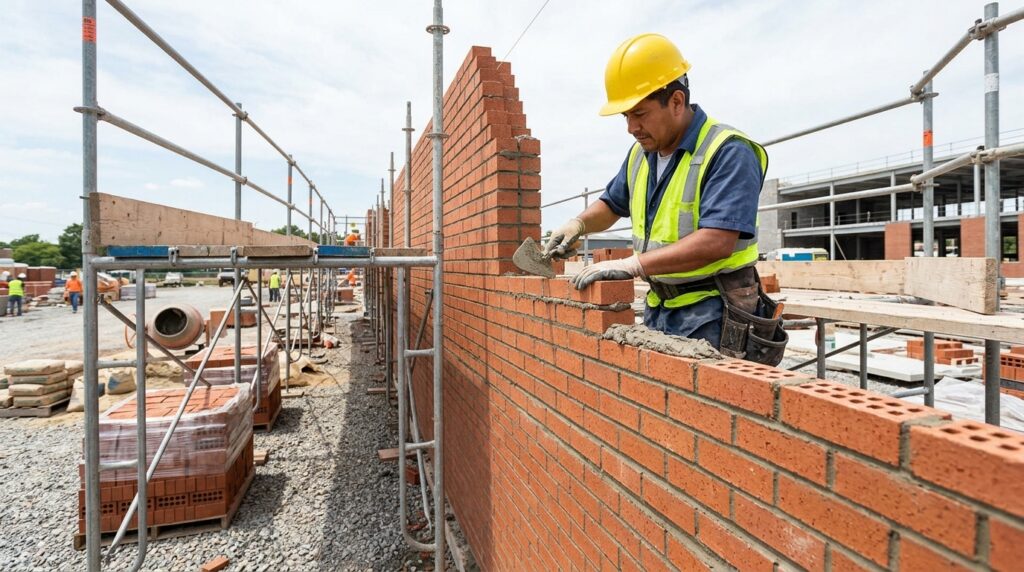
How to Estimate Masonry Material Quantities
Calculating masonry material quantities follows a simple formula — but the details matter. Here’s the step-by-step process our estimators use at Phoenix Estimations on every construction takeoff project.
Step 1: Calculate Net Wall Area
Start with gross wall area (length × height), then subtract openings.
Formula: Net Wall Area = (Wall Length × Wall Height) − (Door Areas + Window Areas)
For a 40′ × 10′ wall with two 3′ × 7′ doors and four 3′ × 4′ windows:
• Gross area: 400 SF
• Door openings: 2 × 21 SF = 42 SF
• Window openings: 4 × 12 SF = 48 SF
• Net wall area: 400 − 42 − 48 = 310 SF
Step 2: Determine Units Per Square Foot
Unit count depends on masonry type and bond pattern:
| Masonry Type | Units Per SF (Running Bond) |
| Modular Brick (3⅝” × 2¼” × 7⅝”) | 6.75 units |
| Standard CMU (8″ × 8″ × 16″) | 1.125 units |
| King-Size Brick | 4.5 units |
| Stone Veneer (average) | Varies — use manufacturer data |
Step 3: Apply Waste Factor
Never skip the waste factor. Cutting, breakage, and damaged units add up.
Standard waste factors:
• Brick: 5–10% (5% for simple walls, 10% for complex patterns or arches)
• CMU: 3–5%
• Stone: 10–15%
Formula: Total Units = (Net Wall Area × Units Per SF) × (1 + Waste Factor)
For our 310 SF brick wall at 6.75 units/SF with 7% waste:
• Base count: 310 × 6.75 = 2,093 bricks
• With waste: 2,093 × 1.07 = 2,240 bricks
Step 4: Calculate Mortar Quantity
Mortar quantity depends on joint size and unit type. For standard ⅜” joints:
| Masonry Type | Mortar Bags Per 100 Units |
| Modular Brick | 7–8 bags (80 lb) |
| Standard CMU | 3–4 bags (80 lb) |
For 2,240 bricks: approximately 160–180 bags of mortar.
Step 5: Add Accessories
• Wall ties: 1 per 2.67 SF of veneer (minimum code requirement — check local codes)
• Flashing: Linear feet at base, shelf angles, and openings
• Control joints: Every 20–25′ horizontally in CMU walls
A complete quantity takeoff captures all these items automatically.
Masonry material calculations can get complex fast. Skip the manual work — Phoenix Estimations delivers precise masonry takeoffs and cost estimates. Get yours →
Masonry Labour Costs: What to Budget Per Square Foot
Labor represents 50–60% of total masonry work cost. Getting this wrong sinks your estimate.
Masonry labour cost per square foot varies by region, project complexity, and wall type. Here are ballpark ranges for the US and Canada in 2025–2026:
US Market Ranges
| Masonry Type | Labor Cost Per SF (Material + Labor) |
| Brick Veneer | $15–$35/SF |
| CMU (Structural) | $12–$25/SF |
| Stone Veneer | $25–$50/SF |
| Natural Stone | $40–$80/SF |
Canadian Market Ranges
| Masonry Type | Labor Cost Per SF (CAD) |
| Brick Veneer | $20–$45/SF |
| CMU (Structural) | $15–$30/SF |
| Stone Veneer | $30–$60/SF |
These are ranges, not quotes. Regional labor markets, union vs. non-union, project access, and wall height all affect final pricing. Urban markets like Toronto, New York, and California run 20–30% higher than rural areas.
Factors That Increase Labor Cost:
• Height: Walls above 8′ require scaffolding — add $2–$5/SF
• Complexity: Arches, soldier courses, and decorative patterns slow production
• Access: Tight sites or interior work reduces mason productivity
• Weather: Cold weather protection and heating add cost in northern climates
• Repair work: Masonry repair cost per square foot runs higher than new construction — matching existing work takes time
Production Rates to Check Your Numbers:
An experienced mason lays approximately: 300–500 modular bricks per day, 80–120 CMU per day, or 35–75 SF of stone veneer per day. If your labor hours don’t align with these rates, check your assumptions.
Common Mistakes in Masonry Cost Estimating
These five mistakes cause the most budget overruns on masonry projects. Every one is avoidable.
1. Skipping the Waste Factor
Estimators who calculate exact unit counts lose money. Cutting around openings, corner returns, and pattern matching all create waste.
Impact: Missing 7% waste on a 10,000-brick job means 700 bricks you didn’t price — roughly $700–$1,400 in materials alone.
2. Using Wrong Mortar Joint Size
Mortar joint size affects mortar quantity significantly. A ½” joint uses 30% more mortar than a ⅜” joint.
Fix: Check specifications and existing conditions (for repairs) before calculating mortar.
3. Missing Accessories
Wall ties, flashing, weep vents, lintels, and control joint materials add 5–10% to material costs. Experienced estimators include these automatically. New estimators forget them.
4. Ignoring Scaffolding Costs
Scaffolding rental and labor to erect/dismantle adds $2–$6/SF depending on height and duration. On a two-story building, that’s thousands of dollars.
5. Underestimating Repair Complexity
Masonry repair cost estimation requires matching existing materials. Finding matching brick, cutting out damaged sections, and blending new mortar color takes 2–3× longer than new construction.
When estimating chimney masonry repair cost or historic restoration, double your labor assumptions for matching work.
Masonry estimating errors are among the most expensive on a job site. Our team catches every one. Send us your plans →
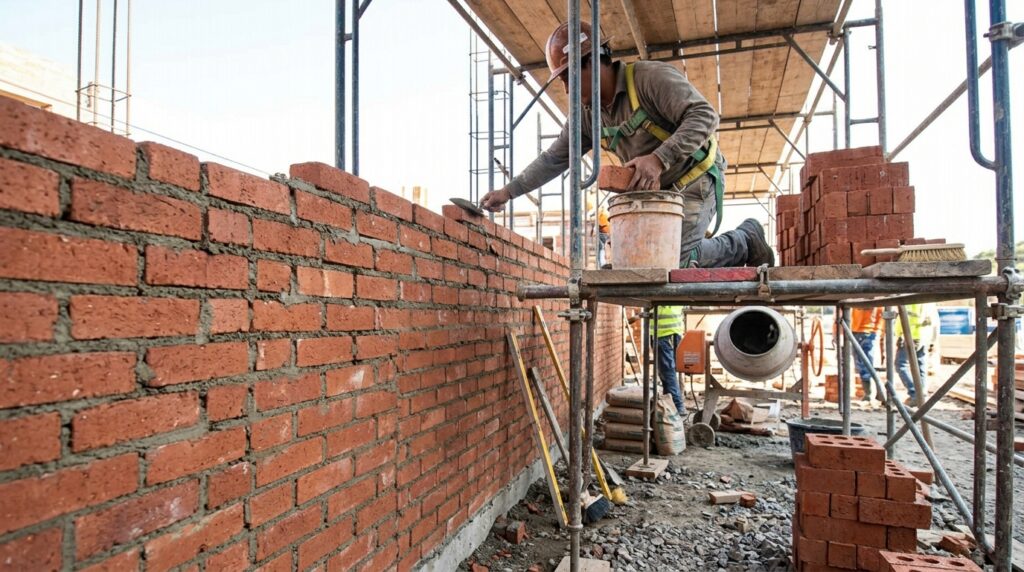
When Professional Masonry Estimating Saves Money
You can estimate masonry costs yourself — for simple projects, the formulas above work. But complexity changes the math.
Large commercial masonry scopes involve thousands of square feet across multiple wall types, alternating bond patterns, and coordinated trades. A hospital or school with load-bearing CMU, brick veneer, and stone accents requires systematic takeoff methods and experienced judgment.
Tight bid deadlines make DIY estimates risky. Rushing a masonry takeoff leads to the mistakes above — and losing money beats losing the bid.
Renovation and repair work demands matching expertise. Calculating masonry repair cost for a 100-year-old building means identifying existing materials, assessing structural conditions, and pricing work that can’t follow standard production rates.
At Phoenix Estimations, we use PlanSwift, Bluebeam, and RSMeans data to deliver accurate masonry estimates — trade-by-trade, with waste factors built in. We’ve handled projects from retail renovations to university expansions where masonry precision determined bid success.
Real-World Example: The KEG, Dixon Road
The KEG Dixon Road project faced budget discrepancies from inaccurate exterior construction cost estimates — including masonry veneer and structural elements. Our team delivered precise material, labor, and overhead cost estimates using advanced takeoff tools and RSMeans methodology. The accurate breakdown resolved the discrepancy and kept the project on track.
Frequently Asked Questions
Q: How much does masonry work cost per square foot?
A: Masonry work cost ranges from $12–$35/SF for brick and CMU in the US, and $15–$45/SF in Canada. Stone veneer runs $25–$80/SF depending on material type. These ranges include materials and labor but vary by region, complexity, and project access conditions.
Q: What waste factor should I use for brick masonry?
A: Use 5–7% waste for simple running bond walls with minimal cuts. Increase to 10% for complex patterns, arches, or walls with many openings. CMU typically needs 3–5% waste. Stone veneer requires 10–15% due to irregular sizing and cutting.
Q: How much does masonry repair cost compared to new construction?
A: Masonry repair cost typically runs 1.5–3× higher than new construction per square foot. Matching existing brick, cutting out damaged sections, and blending mortar colors requires more labor. Chimney masonry repair cost and historic restoration work at the higher end of this range.
Q: What is included in masonry labor cost?
A: Masonry labor cost includes mason wages, laborer/tender support, scaffolding setup and rental, mortar mixing, material handling, and cleanup. Labor typically represents 50–60% of total installed masonry cost. Complex work, height, and poor access increase labor portions.
Q: How do you calculate mortar quantity for brick?
A: For modular brick with ⅜” joints, budget 7–8 bags (80 lb) of mortar per 100 bricks. Multiply your total brick count (with waste) by this factor. Larger joints or different brick sizes change the ratio — always verify against spec requirements and adjust for job conditions.
Key Takeaways
• Masonry estimates include materials, accessories, labor, and scaffolding — missing any category guarantees a blown budget
• Use the wall area formula with proper waste factors — 5–10% for brick, 3–5% for CMU, 10–15% for stone
• Labor is 50–60% of masonry work cost — verify your hours against standard production rates
• The top mistakes are skipping waste, wrong joint size, missing accessories, and underpricing repair work — all avoidable with systematic takeoffs
• Professional masonry estimating pays off on complex, large, or time-sensitive projects — Phoenix Estimations delivers trade-specific accuracy
Ready for Accurate Masonry Estimates?
Accurate masonry estimates start here. Whether you’re pricing a new CMU structure, brick veneer façade, or calculating masonry repair cost for a renovation, Phoenix Estimations delivers the precision your bid needs.
We’ve completed masonry estimating for 2,000+ projects across residential, commercial, and industrial sectors in the US and Canada — with turnaround times that match your bid schedule.
👉 Get a Professional Quantity Takeoff
Contact Phoenix Estimations for a detailed breakdown today →
Conclusion
Learning how to estimate masonry costs accurately separates winning bids from costly surprises. The formulas are straightforward — wall area, unit counts, waste factors, mortar quantities. The discipline is applying them consistently.
Whether you’re handling brick veneer, CMU structural walls, or masonry repair cost calculations, the same fundamentals apply: measure twice, account for waste, price labor realistically, and don’t forget the accessories.
For complex projects or tight timelines, professional masonry estimating delivers accuracy without pulling your team off production work. What’s your next masonry project — and are you confident in your numbers?
Resources
• RS Means / Gordian — Industry-standard masonry cost data and regional pricing
• AACE International — Cost engineering standards and best practices
• The Masonry Society — Technical standards and masonry specifications
• ASTM International — ASTM C90 and masonry material standards
• National Concrete Masonry Association — CMU specifications and design resources
About the Author
Phoenix Estimations Editorial Team
This article was written by the estimating professionals at Phoenix Estimations — a construction cost estimating company with 8 years of experience, 2,000+ completed projects, and 4,000+ satisfied clients across the United States and Canada. Our masonry estimating team includes specialists experienced in brick, CMU, stone, and restoration work across residential, commercial, and industrial sectors. We use PlanSwift, Bluebeam, RSMeans, and industry-standard methodologies to deliver accurate, bid-ready masonry estimates.